
Nigeria’s Ebola Response Needs Coordinated Communication to Build Trust
Related Stories






An Ebola response asks people to report symptoms, disclose their movements and accept monitoring that may interrupt their livelihoods. Those requests depend on trust, largely shaped by what public health authorities do and how clearly, consistently and transparently they communicate.
Nigeria confirmed an imported case of Bundibugyo virus disease on 20 October 2026. Investigations are ongoing, with questions about the patient’s full travel history and possible exposures still being examined. As authorities work to establish the facts, clear public communication should distinguish verified information from preliminary findings and explain what remains under investigation.
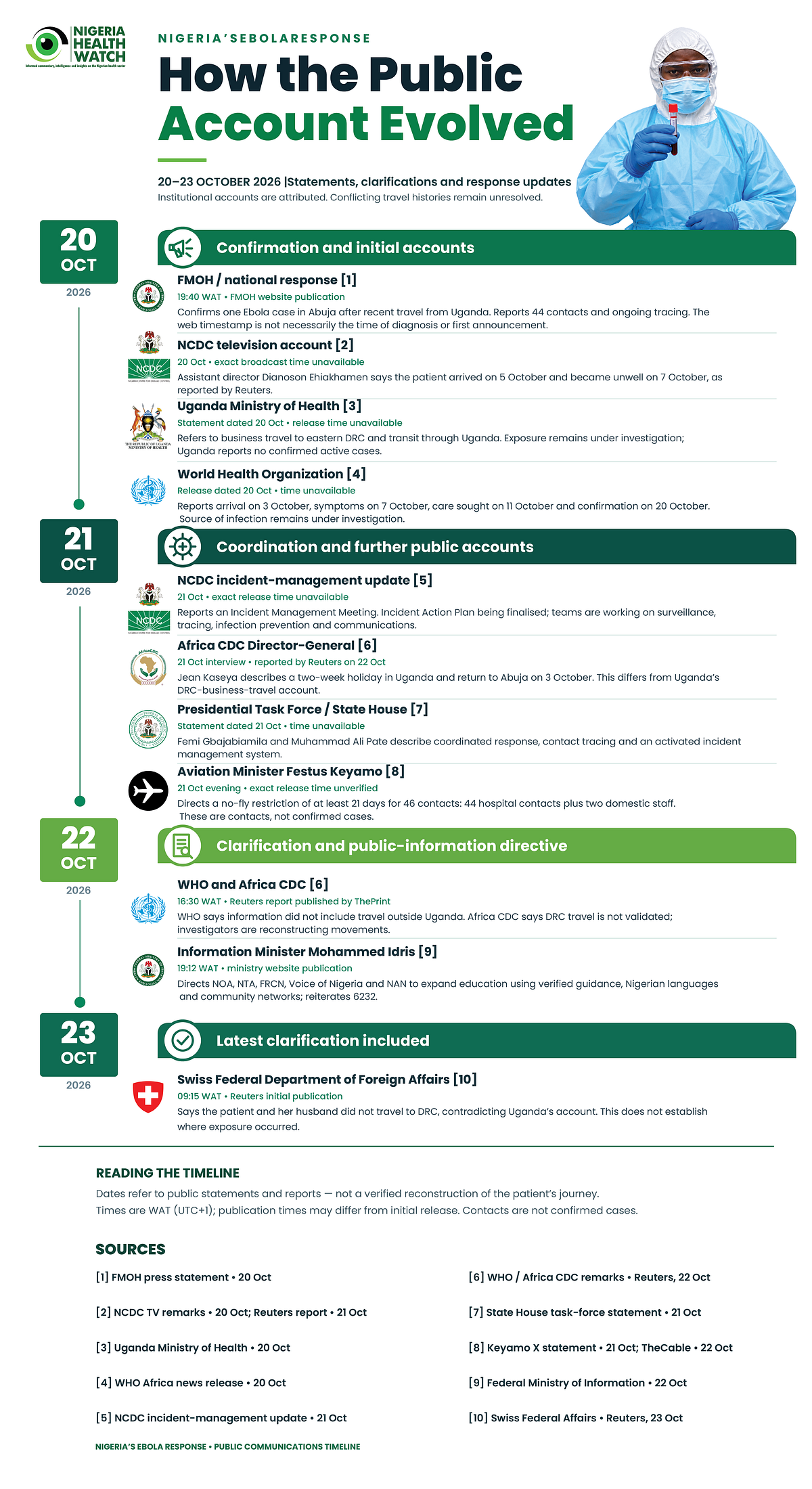
These discrepancies may simply reflect the complexities of an unfolding investigation involving several countries and institutions. However, without timely clarification, these different public accounts can fuel speculation and ultimately weaken public confidence.
We are already beginning to see questions and competing interpretations emerge on social media. These can quickly create space for rumours and misinformation, particularly during an outbreak when anxiety is understandably high.
One of the important lessons from the COVID-19 pandemicis that communication cannot be treated as an afterthought to the public health response. It is an integral part of that response.
Explain uncertainty before suspicion grows
The initial announcements by Nigeria’s Federal Ministry of Health and Social Welfare (FMoHSW), and the World Health Organization (WHO) on 20 October described recent travel from Uganda.
Uganda’s Health Ministry later on 20 October referred to business travel to eastern Democratic Republic of the Congo (DRC) and transit through Uganda, while clarifying that transit did not necessarily establish where the infection occurred. On 22 October, WHO and Africa CDC indicated that travel to DRC had not yet been verified.
These differing accounts may reflect information emerging at different stages of the investigation. It is clear that establishing a patient’s movements across several countries takes time, and it is reasonable for some details to remain unconfirmed.
What matters is how that uncertainty is communicated. Public health authorities should work towards a shared account of the verified facts, clearly distinguish what is known from what remains under investigation and provide regular updates as new information becomes available.
There is also a need to balance transparency with respect for the patient’s privacy. Public speculation about the patient’s nationality or identity risks stigmatising individuals and communities while distracting from the epidemiological questions that matter most.
As we saw during the COVID-19 pandemic, in an outbreak, even legitimate differences in preliminary accounts can contribute to confusion if they are not adequately explained. Questions about the patient’s travel history, the timeline of diagnosis and the country’s preparedness are legitimate and should be met with openness rather than defensiveness.
Make communications leadership clear and visible
One of the most important priorities now is to establish coordinated public communications with consistent messaging across the different responding organisations.
The presidential task force is chaired by Chief of Staff to the President, Femi Gbajabiamila, while its communications subcommittee, inaugurated in July, is chaired by Information Minister Mohammed Idris, with Minister of State for Foreign Affairs Sola Enikanolaiye as deputy.
On 22 October, Idris directed public information agencies to expand public education using verified health guidance. The Nigeria Centre for Disease Control and Prevention (NCDC) had, by 28 May, activated its national Emergency Operations Centre in alert mode.
On 23 October, Health Minister Professor Muhammad Ali Pate clarified that genetic similarities between the viruses identified in Nigeria and Kenya did not, by themselves, establish a direct transmission link. The same statement announced NCDC’s plans for short daily public updates from 24 October.
NCDC has also mobilised infection prevention and control professionals and media fellows to strengthen preparedness. Building on these steps, ministerial briefings and NCDC updates should provide consistent, verified information, explain what remains under investigation and give the public clear, practical guidance.
These are important arrangements, but the public needs to know where to turn for authoritative, up-to-date information. Different agencies issuing separate press statements, sometimes with different details, risk creating the impression of a fragmented response, even where coordination may be happening behind the scenes.
At a time like this, the priority should be building public confidence in the response. There should be a clearly designated lead for outbreak communications, supported by an agreed protocol for how information is verified, cleared and shared across institutions.
The Information Ministry and other relevant agencies should support the dissemination of consistent messages through their respective channels. The same principle should extend to regional and international health partners. WHO, Africa CDC and neighbouring countries have essential roles in outbreak investigation and response, particularly where cross-border movements are involved.
Their ability to communicate independently remains important. However, when discrepancies emerge, there should be established channels for rapidly clarifying the facts with national authorities before issuing potentially contradictory public accounts.
Where differences cannot be resolved immediately, institutions should be transparent about what remains under investigation rather than presenting competing versions of events. Journalists should have a clear point of contact for verification, and the public should know when to expect the next update.
An outbreak response involves many institutions, each of which makes an important contribution. With a global audience watching, and perceptions of the country’s response capacity shaping confidence, clear communication becomes especially important. Effective public communication requires clarity of leadership, discipline in messaging and a shared commitment to public trust.
Earn trust through practical answers
Nigeria’s COVID-19 response offers us lessons. The Presidential Task Force (PTF) provided a recognisable platform for public communication, bringing together officials from different agencies through regular briefings and coordinated updates.
Nigerians heard from the NCDC, the Federal Ministry of Health, and other institutions, all within a structure that made clear how their respective roles fit into the national response. The PTF on Ebola can adapt this structure. It can provide clear leadership, agreed messages, and the discipline to communicate as part of a single national response.
Beyond coordinating public statements, effective outbreak communication must also involve listening to communities, understanding their concerns and responding with practical answers.
NCDC and the National Orientation Agency should draw on lessons from COVID-19 by combining hotline enquiries, community feedback, and public social media monitoring to identify emerging questions, rumours, and concerns, and then provide answers through the channels where they arise.
Members of the public can report suspected cases through NCDC’s toll-free, 24-hour emergency line, 6232. Rumours about cures or suspected cases should be assessed for their potential harm and addressed promptly, without unnecessarily amplifying them.
Equally, when public concerns reveal problems with referral pathways, access to testing or the costs of seeking care, the response must go beyond correcting the message to addressing the underlying problem.
Radio discussions, WhatsApp voice notes, community leaders and trusted health workers can help explain the risks and necessary precautions in Nigerian languages. Communities need clear instructions on when and how to report symptoms, what contact monitoring involves, where to seek care and how confidentiality will be protected.
Ultimately, the effectiveness of outbreak communication should be measured by whether people understand what is expected of them and trust the system enough to report symptoms and cooperate with public health teams
Every person who feels safe enough to report symptoms strengthens Nigeria’s chances of stopping transmission. It is still early in the response, and there is still only one confirmed case, but this is the time to invest in that trust.
Leave a Comment
Your email address will not be published. Required fields are marked *