
#Vote4HealthNaija: Turning Health Promises into Measurable Commitments Ahead of Nigeria’s 2027 Elections
Related Stories



Health continues to struggle to secure sufficient fiscal and political priority in Nigeria, and the gap between commitments, budget releases, and actual expenditure shows why. Nigeria’s 2026 federal budget allocated 3.7% to health, a figure far below the 15% budgetary target African leaders pledged under the 2001 Abuja Declaration. BudgIT’s 2025 State of States report found that only seven states, Yobe, Gombe, Ekiti, Lagos, Edo, Delta and Bauchi, spent more than 80% of their 2024 health budgets.
The question, therefore, is what will it take for health to be given greater political priority? Once every four years, Nigerians go to the polls, giving political aspirants an opportunity to set out their commitments and explain what they intend to deliver if elected. In some countries, elections can be won or lost partly on the strength of aspirants’ competing health policies. Historically, that has not been the case in Nigeria. Health has rarely carried that level of political weight in Nigeria.

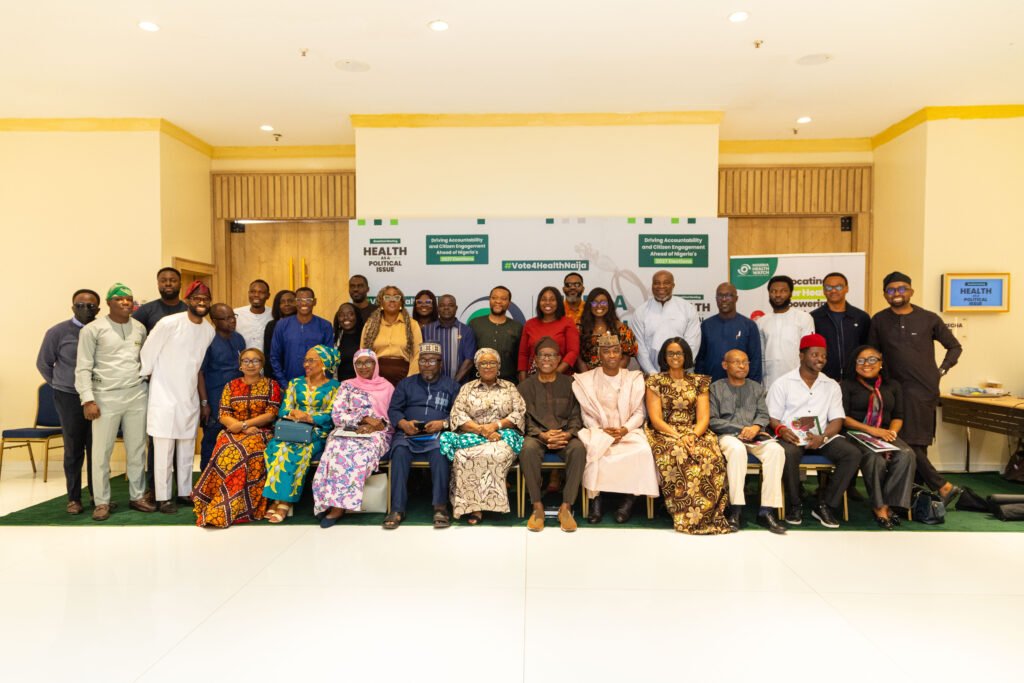
As the 2027 election season approaches, the electoral window is opening for advocacy to push health higher up the political agenda. This means engaging citizens more actively and creating space for civil society and other stakeholders to define what they should expect from political aspirants, and the commitments against which those seeking office should ultimately be held accountable. With the 2027 elections in sight, Nigeria Health Watch convened a breakfast meeting themed “Health as a Political Issue: Driving Accountability and Citizen Engagement Ahead of Nigeria’s 2027 Elections.”
The discussion featured Dr Murtala Muhammad Bagana, Niger State Commissioner for Health, who spoke from the perspective of state-level implementation, and Dr Gafar Alawode, CEO of DGI Consult and co-convener of the Nigeria UHC Forum. Dr Alawode has spent years advocating for health commitments to be written into party manifestos before elections.
A promise must be measurable to be accountable
Dr Bagana reframed the discussions in relation to the meeting’s overall theme. He argued that health should not be framed solely as a moral obligation, but also as an investment that can yield visible political and economic returns. He also pointed out why so many manifesto promises collapse before they reach a budget line. “How do you track and measure something like ‘free medical services’?” he asked. “It’s nearly impossible.”

The fiscal data points to the same implementation problem. Appropriation does not guarantee release or expenditure. During the ministry’s 2026 budget defence in February, Coordinating Minister Muhammad Ali Pate told lawmakers that only ₦36 million of the ₦218 billion appropriated for the ministry’s 2025 capital expenditure had been released.
BudgIT’s 2025 State of States report revealed that Nigerian states collectively spent only 61.9% of the ₦1.32 trillion they had budgeted for health in 2024. The average state spent roughly ₦3,483 per person that year. No state exceeded ₦10,000 per person. Accountability must follow the chain from appropriation to release, expenditure and, ultimately, the services delivered.
Where the promise breaks down
The problem is not only whether candidates make health commitments, but whether those commitments are designed around what the government can realistically finance and deliver. The political actors who formulate campaign promises are not always the technical and administrative actors responsible for implementing them. Dr Bagana explained, “One of the biggest barriers after all the commitment is that the right people are not making the commitment. The right people are not in the room where the commitment is being shaped, or communication is being packaged for them to make those commitments.”
Dr Alawode also challenged health advocates to be more specific about what they want political actors to commit to; “You cannot just tell politicians to prioritise health,” he said. “What, exactly, should they prioritise?”
External funding is becoming less predictable. The OECD’s latest projections estimate that net official development assistance fell by 23.3% in 2025 and could decline by a further 6.9% in 2026. For Nigeria, this global financing squeeze strengthens the case for political commitments that identify realistic domestic financing and implementation pathways.

Who checks whether the money moved?
Conversations in the room highlighted that a well-designed commitment only matters if someone checks whether it happened. Dr Mustafa Lecky of the Health Sector Reform Coalitiontold participants that a review across Kaduna’s 23 LGAs had found major gaps in Ward Development (WDC) knowledge of the BHCPF. “They found that most of the Ward Development Committees (WDCs) knew nothing about the Basic Health Care Provision Fund,” he mentioned. WDCs are community structures intended to support participation, co-management and oversight of PHC facilities.
Additionally, Dr Bagana alluded to a similar gap. As a sitting commissioner, he has had to personally request account statements from the Officers-in-Charge (OIC) managing the Basic Health Care Provision Fund (BHCPF), which he presented as evidence of weak independent scrutiny of facility-level funds.
Chief Mrs Moji Makanjuola, Founder and Executive Director of the International Society of Media in Public Health (ISMPH), extended the accountability challenge to the media. “We are too polite with them,” she told the health correspondents in the room. “We have built the capacity to track budgets, and I am not seeing the results.”
Across government, civil society and the media, the discussion pointed to the same problem. Accountability mechanisms exist, but they are used unevenly and often lack the information, capacity or sustained follow-through needed to influence implementation.

From an argument to an instrument
The meeting also marked the launch of Nigeria Health Watch’s Health Manifesto Tracker. Ahead of the 2027 elections, the tool will capture and assess health commitments made by political parties and candidates, including whether they are specific, measurable and achievable. Once elected officials assume office, its implementation-tracking component will follow those commitments using publicly available evidence.
Nigeria Health Watch also relaunched the #Vote4HealthNaija following earlier campaigns ahead of the 2019 and 2023 elections. This time, the push is for citizens, media and civil society to ask candidates exactly how they intend to make healthcare more affordable, strengthen primary healthcare, and improve maternal health, and to continue demanding evidence of delivery after the votes are counted. The campaign is non-partisan. Its purpose is not to support a candidate or party, but to make health commitments harder to avoid and easier for citizens to interrogate.
This is where the Health Manifesto tracker comes in. Political promises are easy to make and easy to forget once an election is over. A public record gives citizens, journalists and civil society a benchmark against which to assess government performance, measure progress, and make gaps visible. The tracker cannot make every campaign promise achievable. Its value lies in clarifying who promised what, what resources were attached to those commitments, and whether Nigerians ultimately received what was promised.
Campaign promises can sound convincing enough to win votes. The harder test comes afterwards, whether those commitments make their way into health budgets and ultimately, better health services. As former New York Governor Mario Cuomo once put it, “You campaign in poetry. You govern in prose”. For Nigeria’s health sector, what happens after the votes are counted matters most.
Leave a Comment
Your email address will not be published. Required fields are marked *