

“Deliver Like the Hebrew Women”: How Traditional Myths and Religious Misconceptions Fuel Maternal and Child Deaths
Related Stories





Dr Otubo Victor Ogemdi* and Vivianne Ihekweazu (Lead writers)
Sarah lived in Abuja. Ruth lived in Tel Aviv. Both were young, first-time expectant mothers. Both were filled with as much hope as anxiety as their due dates approached. Sarah had the support of her elderly mum and her pastor; “You will deliver like a Hebrew woman,” they always reassured her, “CS is not our portion.”
Ruth is a Hebrew woman; she gave birth in Tel Aviv, in a well-equipped hospital, supported by skilled professionals with emergency care on standby. Both women had eventful labours. Sarah had her faith anchored strongly to deliver like the Hebrew woman. Ruth, a Hebrew woman, on the other hand, had an emergency CS, gave birth, and was discharged a couple of days later. Sarah had prolonged labour in a maternity home in Abuja, and after two days of pain and faith, she passed away. Her baby did not make it either.
Their stories, unfortunately, are neither unique nor isolated. They reflect a deep and painful irony whose statistics and reality confound the very logic that inspires it.
Women in Nigeria are significantly more likely to die in childbirth than the average pregnant woman in Israel. In 2023 alone, Nigeria recorded an estimated 993 maternal deaths for every 100,000 live births. This means that an estimated 75,000 women died in 2023 in Nigeria from pregnancy-related complications. This accounted for nearly 29% of all global maternal deaths for that year, despite Nigeria having under 2% of the world’s population. In very stark contrast, in 2023, the estimated number of maternal deaths in Israel was four, which amounted to 2 maternal deaths for every 100,000 live births.
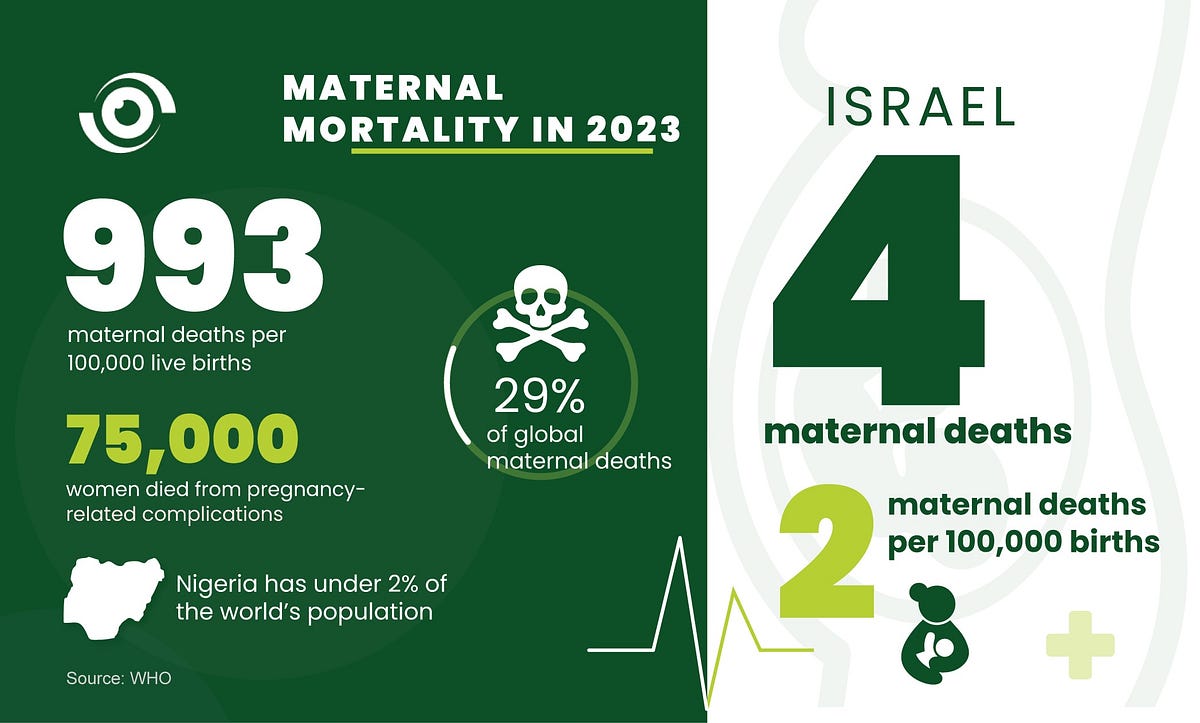
So, the question is: “Why are more women dying in Nigeria trying to deliver like the Hebrew women, whereas the Hebrew women themselves are not dying in as many numbers in childbirth?”
Rethinking what we believe about the Hebrew women
To “deliver like the Hebrew women” is a statement that has spread its roots among the Christian community in Nigeria. Generally, it refers to the conviction that with faith, childbirth will be without any complications.
So, to gain clarity on the issue, medical doctor and pastor Dr Otubo Victor asked 100 Christian women what they understood the phrase to mean, using this as a snapshot to gauge perceptions while acknowledging it was not a full scientific study.
In essence, the exercise explored what women meant when they used the phrase, “I will deliver like the Hebrew women”.For most of the women, it meant “quick delivery and with minimal or zero pain”. 73 out of these 100 women said that in planning to “deliver like the Hebrew women,” they strongly expected childbirth without any need for a Caesarean Section (CS) or medical intervention whatsoever.
What was troubling, however, was that some of the women stated that they would refuse a CS even if medically recommended.
A biblical lesson in delivering like a Hebrew woman
The idea of “delivering like the Hebrew women” comes from the book of Exodus. A new Pharaoh, fearful of the growing Hebrew population, ordered midwives to secretly kill male babies at birth. The midwives, who were Hebrews themselves, did not comply. When questioned, they explained that Hebrew women delivered so quickly that they arrived after the babies had already been born. This explanation was a protective lie, not a biological claim about painless or effortless childbirth.
Over time, this account has been misinterpreted. While it is often taken to mean that Hebrew women experienced quick, pain-free labour without medical intervention, the broader biblical context does not support this.
Throughout the Bible, we are never told that labour would be painless or without some difficulties. In fact, in several passages, Jesus himself acknowledged the contrary:
“…These things are like the first pains of childbirth.” Matthew 24:8; Mark 13:8 GNBDK
“When a woman gives birth, she has a hard time, there’s no getting around it…” — John 16:21 MSG
These passages reinforce that pain in labour is normal, and every woman’s experience may vary. Faith, in this context, should support informed decision-making, including seeking appropriate medical care and following medical guidance when needed. It should also encourage the pursuit of knowledge to gain clarity. This matters because current outcomes suggest gaps in understanding and behaviour; otherwise, Nigeria would not continue to record a significantly high maternal mortality rate (MMR).
It must be stated that this high maternal mortality rate is not being solely attributed to misconceptions, as there are other compounding factors that contribute to these outcomes.
The proverbial “Hebrew women” in historical texts have been women who engaged skilled health professionals, delivered in safe and well-equipped settings, and consented to medical advice and interventions when necessary. This is how they continue to deliver till this day, and this is how our women ought to be taught to “deliver like the Hebrew Women”.
So, how did this myth of delivering “like the Hebrew women” become misconstrued and the false narrative now enshrouded in our beliefs and tradition? Religious interpretation has played a significant role in shaping how this narrative is understood today. Other compounding factors have contributed to this indoctrination and the eventual poor maternal and child outcomes.
How culture and religion shaped beliefs around childbirth
Across many cultures in Nigeria, before and beyond religion, it is a source of pride, almost a badge of honour, for women to deliver at home, alone and unassisted. In some communities, this is seen as a test of strength, built on the assumption that a “strong woman” should endure childbirth without help or intervention. The absence of a witness is often seen as proof of resilience and ability.
And this is how it connects to all of us. We are largely shaped by the beliefs and traditions that influence how we live and make decisions. So, when religious beliefs find common ground with deeply held cultural values, they reinforce one another and form powerful ideologies and social norms that persist, even when they are harmful.
These social norms play a critical role here. They are the unwritten rules people follow, shaping behaviour and sustained by shared expectations, reinforced through approval or disapproval within communities. So, even when these norms are based on misinterpreted beliefs, they are hard to question and even harder to change. The result is a mix of beliefs and expectations that continue to influence decisions around childbirth, often with serious consequences for women’s health.
Hear this story
I recall receiving a late-night call from a church member in prolonged labour who refused a Caesarean Section, insisting that no one in her family had ever had one. She explained, “Pastor, I cannot have a CS. Nobody in my family has ever had a CS. It cannot start with me…”
She would not accept the doctor’s recommendation without first seeking pastoral guidance. After speaking with her doctor, it became clear that she had already been in labour for several hours, at a maternity home, and was now facing complications before being brought to the health facility. Her baby was too large for vaginal delivery and was already showing signs of foetal distress.
I spoke calmly to her and her husband, offering reassurance and a brief prayer. It was only after this encouragement that she agreed to the procedure. Though I am a medical doctor, my influence did not come from my medical authority, but from the trust she placed in me as her Pastor. The surgery was successful, and both mother and child survived.
We can stop Pharaoh…
Through misinterpretation of scripture from some pulpits, the norms passed down by our mothers, and the myths and misinformation that people continue to cling to, women are sometimes encouraged to rely on faith alone, and sometimes against medical advice, on issues that affect childbirth. This is not to suggest that faith is unimportant. We all have deeply held beliefs that shape who we are. However, every time a woman bleeds to death while waiting for a miracle, we must recognise that her death was preventable.
And this is where knowledge and expert care step in. Much can be done to improve maternal outcomes if our health systems are strengthened by leaders at all levels. Religious leaders should encourage women and families to embrace professional health care services. Health institutions should take much care to treat pregnant women with care and dignity, so they are discouraged from patronising unskilled birth attendants, who often provide empathetic care, making them a preferred alternative to skilled health workers. If we do these things, maybe we could start moving from a country with the highest global rate of maternal mortality, in pursuit of the figures in Israel, where our fellow women of faith are delivering more safely.
About Dr OVO (Otubo Victor Ogemdi)*
Dr OVO is a medical doctor. He believes that maternal and child mortality can be reduced through health education that both informs and influences people and communities to adopt better health-seeking behaviours.
01 Comment(s)
Leave a Comment
Your email address will not be published. Required fields are marked *
[…] Globally, Nigeria is the 4th country with the highest rate of maternal deaths, and one of the contributors to this tragedy is the rejection of Caesarean birth. According to a clinical review published on PMC, a significant number of pregnant women, roughly 22% (1 in 5), facing severe complications during delivery actively resist recommended C-sections. A major contributor to this resistance is the nationwide acclaimed “Hebrew Women Ideology”. […]
When Survival is Labelled Weakness: The Stigma of Caesarean Birth – Naija Feminists Media
July 9, 2026 at 11:24 am