
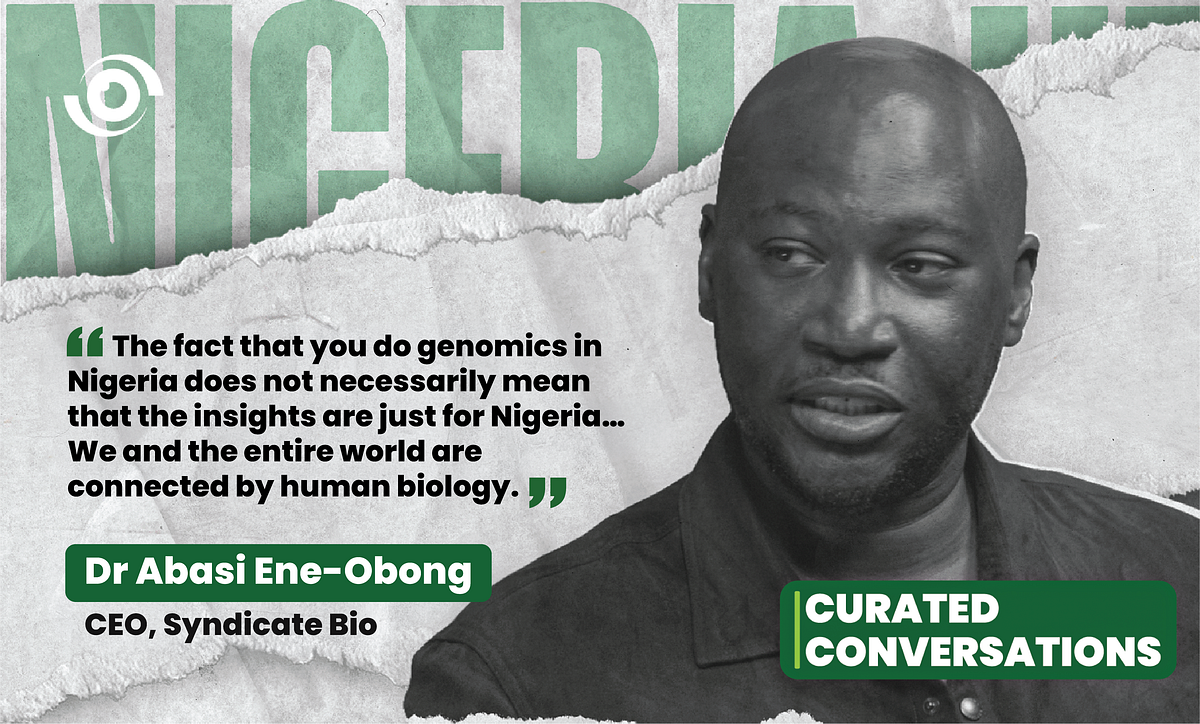
Curated Conversations: Dr Abasi Ene-Obong on Why Nigeria Must Own Its Genomic Future
Related Stories




“The fact that you do genomics in Nigeria does not necessarily mean that the insights are just for Nigeria…We and the entire world are connected by human biology.” — Dr Abasi Ene-Obong
Africa has the most genetically diverse populations in the world. It also contributes the least data to the science that produces new medicines. Dr Abasi Ene-Obong, a biomedical scientist, founder and chief executive officer of Syndicate Bio, and co-founder of 54gene, sees that as a failure of science and a failure of strategy.
In the latest edition of Nigeria Health Watch’s Curated Conversations, Dr Ene-Obong explains why Africa’s genetic data matters, why the gap begins at home, and what Nigeria must do to turn its science into medicines, jobs and industry.
His father was one of Nigeria’s pioneering plant geneticists, and Dr Ene-Obong was among the first people in the country to study genetics as an undergraduate. He chose it over medicine because it “held the promise to find cures.” He argues that genetics underlies almost every disease, including infectious diseases.
Africa’s genes are already making the world’s medicines
For Dr Ene-Obong, the value of African genomes lies in their variation. Studying disease across many different populations can reveal biology that affects everyone, including biological pathways that lead to new medicines.
His example is PCSK9 inhibitors, a class of cholesterol drugs. Researchers in Texas found people of African ancestry whose PCSK9 gene was switched off, leaving their LDL cholesterol unusually low while they lived normal lives.
That discovery showed scientists that the gene could be safely targeted. One of the resulting medicines, Repatha, earned Amgen more than $2.2 billion in 2024.“That drug is not sold in Africa, by the way, even though the insight was seen in an African woman,” he said.
The gap also affects safety and equity. If clinical trials exclude people with the genetic makeup of the populations expected to use a medicine, developers have limited evidence of how well it will work for them. Yet people of African ancestry make up only about 1.1% of participants in genomic studies, compared with roughly 86% of European ancestry.
“It’s funny because it should be the other way around,” he said.“Modern humans started in Africa. Africa is the most diverse. Our genes are just so rich in insights, yet we happen to have the least amount.” In his view, that imbalance holds back scientific discovery globally and leaves Africans with less equitable healthcare.
There is a race for Africa’s genetic data
When asked whether global powers are competing for Africa’s health data, Dr Ene-Obong responded, “Yes, I would say that there is a race.” His years at 54gene exposed him to the geopolitics of the genomics industry. But he does not begin with external actors. He begins with Nigeria’s own weaknesses.
Many medical schools teach molecular biology as a single, shallow module, and some genetics programmes have no laboratories. COVID-19 showed what that cost. In March 2020, only five laboratories in Nigeria’s national molecular network could test for the virus. He traces both problems to a policy gap where there is too little funding for life sciences and research and development.
Other governments treat genetic data as a national asset. The United Kingdom has read the full DNA of 500,000 volunteers through UK Biobank. The United States is building a database of one million people through All of Us. Researchers and companies draw on these databases to study disease and develop new products, so the benefits stay within those countries’ own research and industries.
Dr Ene-Obong believes many African leaders do not yet see genetic data this way. If that does not change, he warned, Africa risks “mortgaging our healthcare data” for short-term gains and giving away its sovereignty. He went further by comparing genetic data to minerals. With both, sovereignty matters because the value lies not only in extraction but also in processing, ownership, and the ability to turn resources into products.
COVID-19 made that risk concrete. When global supply chains tightened, Nigeria struggled to import automated testing equipment and kits. 54gene secured priority access in part because Dr Ene-Obong knew leaders at several manufacturers. “This goes to sovereignty, when you don’t have the tools you need,” he said.
Nigeria is training scientists for the world
Nigeria’s genomics ambition also depends on retaining the people who can deliver it.
At 54gene, Dr Ene-Obong recalled that companies in Canada, the United States, the Netherlands and the United Kingdom often saw the company as a source of skilled recruits. Pay mattered, but it was not the only issue. Researchers also weighed security, quality of life and career opportunities.
He recalled a husband and wife on his team who enjoyed their work and did not want to leave Nigeria. After violence near their home forced them to take cover with their young baby, they relocated abroad within weeks.
“There’s no place like home,” he said, but he also sees a structural pull. As Western populations age, those countries need more doctors and scientists than they can train. Nigeria, he argued, ends up sending tens of thousands of highly skilled health workers abroad.
If that flow cannot be stopped, Nigeria should at least benefit from it. He believes countries that recruit Nigerian health workers should contribute to the system that trained them, with the resources invested in hospitals, laboratories and health services.
Nigeria’s National Policy on Health Workforce Migration, approved in 2024, does not yet go that far. For Dr Ene-Obong, this is where policy and sovereignty meet. Retention must also begin with the people who train scientists. He noted that a professor’s salary today is similar to what his parents earned as professors in 1999, despite years of inflation.
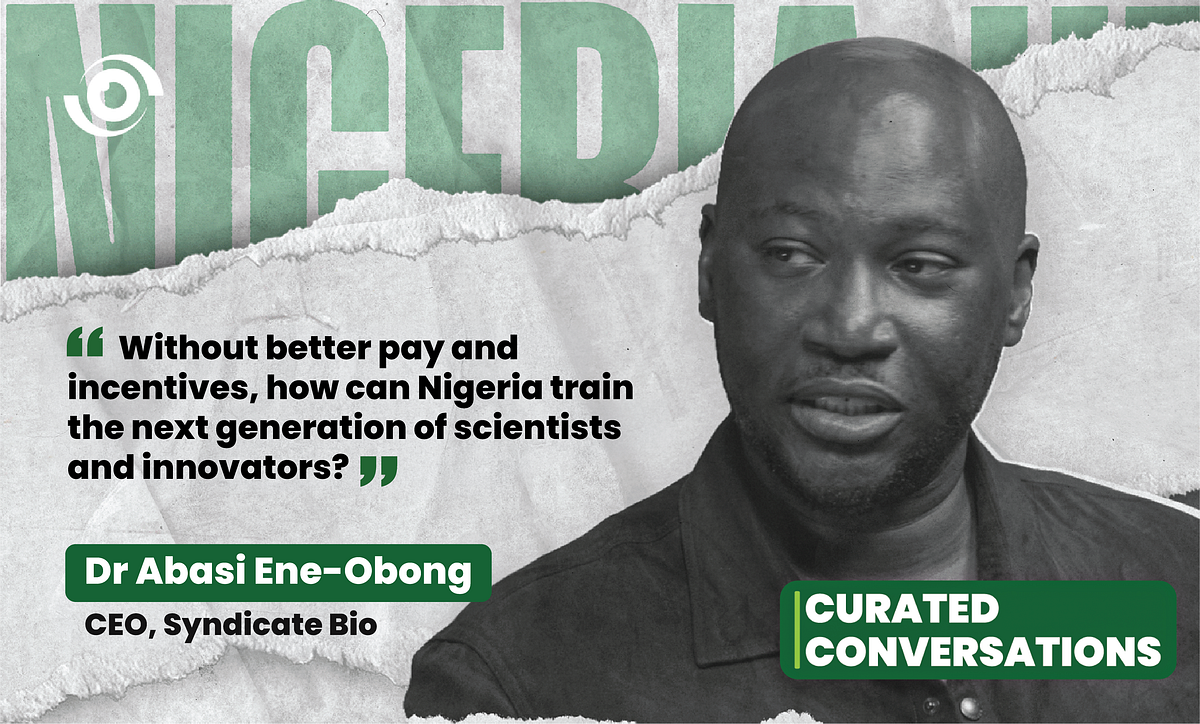
“Without better pay and incentives,” he asked, “how can Nigeria train the next generation of scientists and innovators?”
Government has to build the bridge
Dr Ene-Obong has also seen what public-private partnership can achieve.
Before the pandemic, he said, the Nigeria Centre for Disease Control and Prevention (NCDC) told him it did not really work with the private sector. When COVID-19 arrived, its then Director-General, Dr Chikwe Ihekweazu, opened the space, allowing 54gene to join the national testing network, train molecular scientists, purchase equipment for government laboratories and test about 10,000 stranded Nigerians returning home.
“It taught me that it’s possible,” he said. “When the factors are aligned and correct, it’s a win-win.”
Since then, he believes Nigeria has fallen back into working in silos. The bigger gap is financing. He argued that Nigeria lacks the kind of early-stage public funding that carries scientific ideas from inception to the point where private investors can support them. Private investors want clear entry and exit points, so government has a role in financing the riskier early stage.
Nigeria’s National Research Fund awarded ₦7.5 billion to 174 research teams in its 2025 cycle. Dr Ene-Obong described public research funding as roughly $7 million a year, which he considers far too small for a country of Nigeria’s size.
China shows that a country can change its position. Its share of the global drug development pipeline rose from 18% in 2021 to 31% by early 2026. “So it’s possible to do,”he said. “We just have to have a plan, and it has to be a long-term plan.”For now, he wants to contribute by building some of the businesses needed to do the difficult work.
Africa’s genes are already shaping the world’s medicines. Whether Nigerians share in the benefits will depend on leaders who take an interest in science, on training and retaining researchers, and on funding the long road from laboratory to market.
“Drip, drip, and you will break the rock by using drops of water, so long as it’s consistent.” — Dr Abasi Ene-Obong
Leave a Comment
Your email address will not be published. Required fields are marked *