
Another Office or a Stronger System? The Institutional Test for Nigeria’s Digital Health Agenda
Related Stories





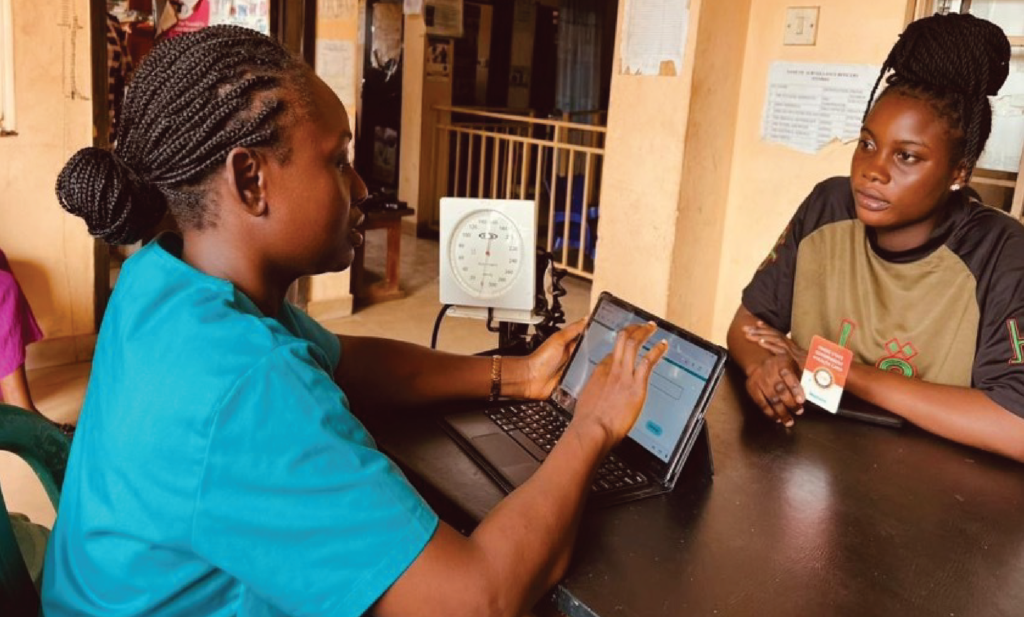
On 26 June 2026, President Bola Ahmed Tinubu approved the establishment of the National Health Technology and Data Analytics Office (NHTDAO) and appointed Dr Obi Adigwe as its pioneer National Coordinator. The decision shows that the government now recognises the central role of digital systems and reliable data in health sector transformation.
According to the Presidency, NHTDAO will reside in the Office of the Coordinating Minister of Health and Social Welfare. The office is expected to coordinate public and private sector digital health work, establish common standards and support implementation of the National Digital Health Architecture approved by the National Council on Health in November 2025. The announcement also says the office will “reinforce, not replace” existing statutory functions.
Nigeria needs stronger digital health leadership, but the creation of an office is not, by itself, evidence that coordination has improved. NHTDAO’s value will depend on what it changes in practice. It could resolve long-standing coordination problems and strengthen DHPRS, state institutions and other existing bodies. But if it creates separate staffing, platforms, budgets and reporting systems, it may deepen the fragmentation it was established to address.
Digital health leadership should connect the system, not create new silos
Reliable and timely data helps government direct resources where they are needed, detect outbreaks earlier, monitor service quality and hold institutions accountable. They can also improve continuity of care, reduce delays and help facilities identify patients who are being missed by essential services.
Digital health leadership should connect the system, not create new silos
Reliable and timely data helps government direct resources where they are needed, detect outbreaks earlier, monitor service quality and hold institutions accountable. They can also improve continuity of care, reduce delays and help facilities identify patients who are being missed by essential services.
Yet Nigeria’s health information landscape remains fragmented. The Federal Ministry of Health and Social Welfare has acknowledged weak data availability, disconnected digital platforms, paper-based processes and limited standardisation. The National Digital Health Initiative (NDHI), launched in March 2024, was intended to address some of these problems through interconnected health information and health claims exchange systems.
In its Global Strategy on Digital Health 2020–2027, the World Health Organization (WHO) emphasises that digital transformation involves more than introducing new software. National strategies should strengthen health systems and bring together financial, organisational, human and technological resources. New technology will achieve little without clear governance, systems that can exchange information, capable institutions and funding that can be sustained.
What gap is the office designed to fill?
Every new public office should be able to explain what it will do that existing arrangements cannot. Government should explain what authority NHTDAO will have and what coordination problem it is expected to solve. It should also show why a new office is preferable to stronger existing departments or a formal arrangement between the institutions already working in digital health.
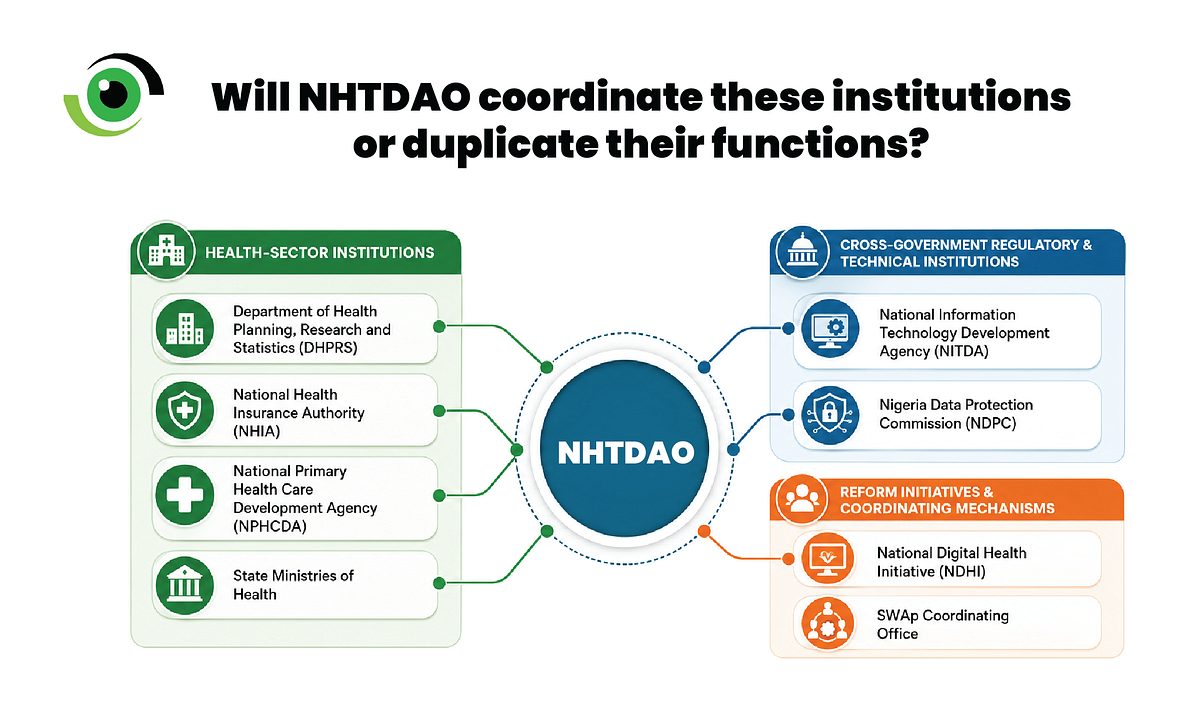
Nigeria already has institutions and initiatives with responsibilities in health data and digital governance. Within the Federal Ministry of Health and Social Welfare, the Department of Health Planning, Research and Statistics (DHPRS) is responsible for coordinating the National Health Management Information System, collecting and analysing health data, monitoring programmes and supporting health sector planning and research.
Responsibility for digital health governance does not rest with the health ministry alone. The National Information Technology Development Agency (NITDA) develops standards and provides oversight for government information technology projects. The Nigeria Data Protection Commission regulates the processing of personal data, including sensitive health information. National cybersecurity institutions provide guidance and incident response capacity.
NHTDAO also enters an active reform landscape that includes the National Digital Health Initiative (NDHI), the National Health Sector Renewal Investment Initiative and the Sector-Wide Approach. NHTDAO’s steering committee will include representatives of DHPRS, NITDA, the SWAp Coordinating Office, the National Health Insurance Authority (NHIA), the National Primary Health Care Development Agency (NPHCDA) and six state ministries of health.
The Presidency has explained how the office will relate to existing institutions. What remains unclear is how this arrangement will work in practice. Stakeholders still need to know which institution will be responsible for each function, how decisions will be made, and how the office will interact with state governments, regulators, private providers and development partners.
Coordination depends on clearly defined roles
OECD guidance acknowledges that central coordinating bodies can help governments move priority reforms forward. It also cautions that several bodies with overlapping mandates can slow decisions rather than improve them. NHTDAO will need a published mandate, clear reporting relationships and regular evaluations of its effectiveness and continued relevance.
Recent proposals to establish additional health sector parastatals have renewed concerns about overlapping mandates and institutional proliferation. However, NHTDAO differs in both its proposed mandate and governance arrangements. It has been announced as an office under the Coordinating Minister of Health and Social Welfare, not as a separate statutory parastatal. Government should define the problem NHTDAO is expected to solve, explain what the office will add and specify which responsibilities will remain with existing institutions.
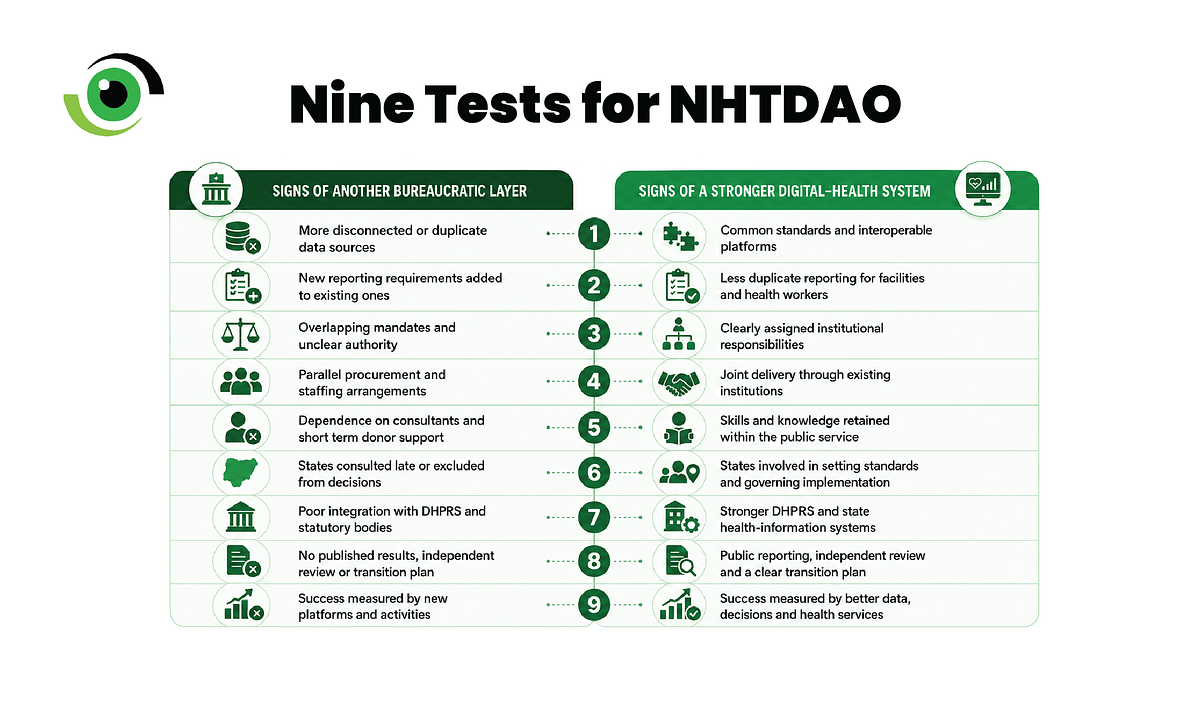
The office could worsen fragmentation if it creates separate procurement arrangements, staffing structures and reporting systems. Its contribution will be more valuable if it establishes common standards and helps existing institutions build the skills and systems they currently lack.
Strengthen the institutions that must sustain the work
NHTDAO should strengthen DHPRS and state health information systems rather than draw resources away from them. This will require more than concentrating technical expertise within the new office. Nigeria needs sustainable public service careers in health informatics, statistics, data engineering, privacy, cyber security and programme management.
The Office of the Head of the Civil Service has already identified digital capability as an important part of public service reform. NHTDAO should contribute to this civil service reform by setting measurable targets for staff training, professional development and the transfer of technical responsibilities to permanent institutions.
Rwanda’s Ministry of Health has a dedicated directorate for digital systems, including interoperability and systems integration. Nigeria may choose a different structure, but Rwanda shows that specialist digital health expertise can sit within the health ministry itself.
States must help design and govern the system
Most health services and much of the data required for national planning are generated at state, local government and facility levels. A federal office cannot build a complete national data environment through directives from Abuja alone.
Including six state commissioners for health on the steering committee is useful, but government should explain how they will be selected and how the other states will be represented.
States will need reliable electricity, connectivity and equipment. They will also need trained personnel, maintenance funding and support to connect existing platforms to national systems. National systems are unlikely to work if they are designed without considering the constraints facing primary healthcare centres, rural facilities and communities affected by conflict.
Make accountability public from the beginning
Before NHTDAO becomes fully operational, government should publish a document setting out its mandate, authority, reporting arrangements and accountability requirements. Government should also commit to an independent review after a defined period; for example, two or three years, to determine whether the office is reducing duplication, improving the quality and use of health data, and strengthening the institutions responsible for delivering the work.
Where a review finds that particular functions belong permanently within DHPRS, another statutory institution or state health authorities, government should provide a clear process for transferring them. Presidential backing can give digital health restructuring the political momentum it needs. Lasting reform will require domestic funding, meaningful participation by state governments, capable civil servants and integration with the institutions that will continue delivering healthcare after this administration leaves office.
NHTDAO should be judged on whether it connects existing platforms, improves the quality and timeliness of health data, reduces reporting burdens and helps government deliver better services. NHTDAO’s success should not be measured by whether the office becomes permanent. It should be measured by whether Nigeria’s digital health system can endure beyond a particular office, appointee or administration.
Leave a Comment
Your email address will not be published. Required fields are marked *