
Civil Society Is Turning 7-1-7 Data into Advocacy for Faster Outbreak Response
Related Stories




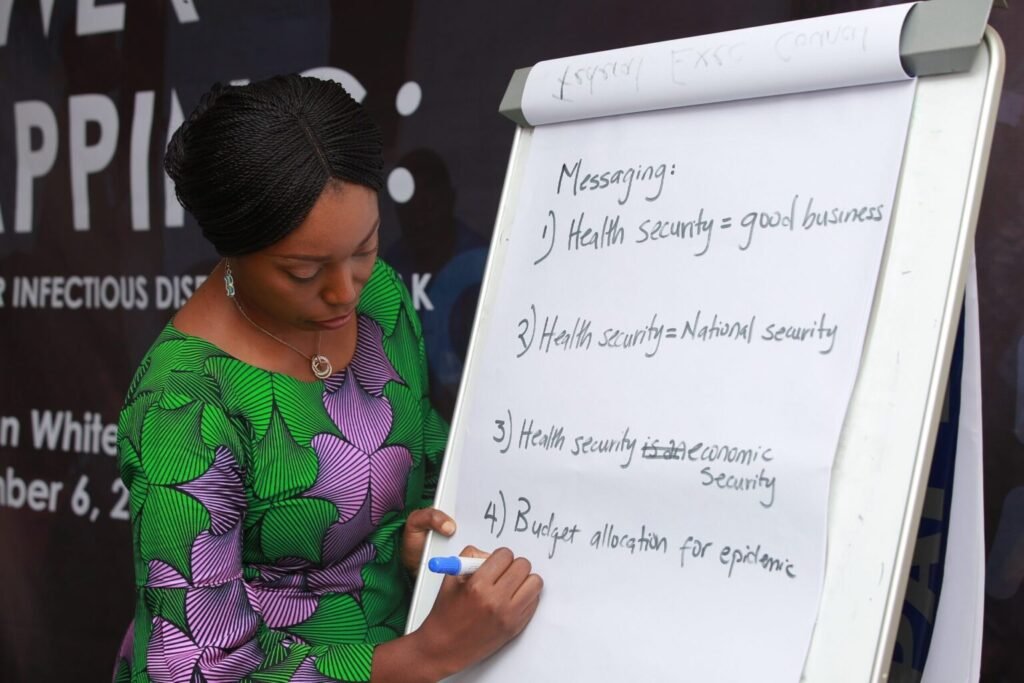
At about 6 p.m. on Tuesday, 20 October, I was finishing this article’s first draft when my phone lit up. The Minister of Health and Social Welfare announced a confirmed Ebola case in Nigeria. The news gave fresh urgency to the questions driving this article. How quickly can Nigeria detect, report and respond to an outbreak? And when the response falls short, how do we turn lessons into action?
Outbreaks do not spread because a country lacks a surveillance system. They spread because, somewhere along the chain, a case went undetected, a sample sat untested, or a response team waited for funds and was not deployed on time. Every lost day gives a pathogen more room to spread.
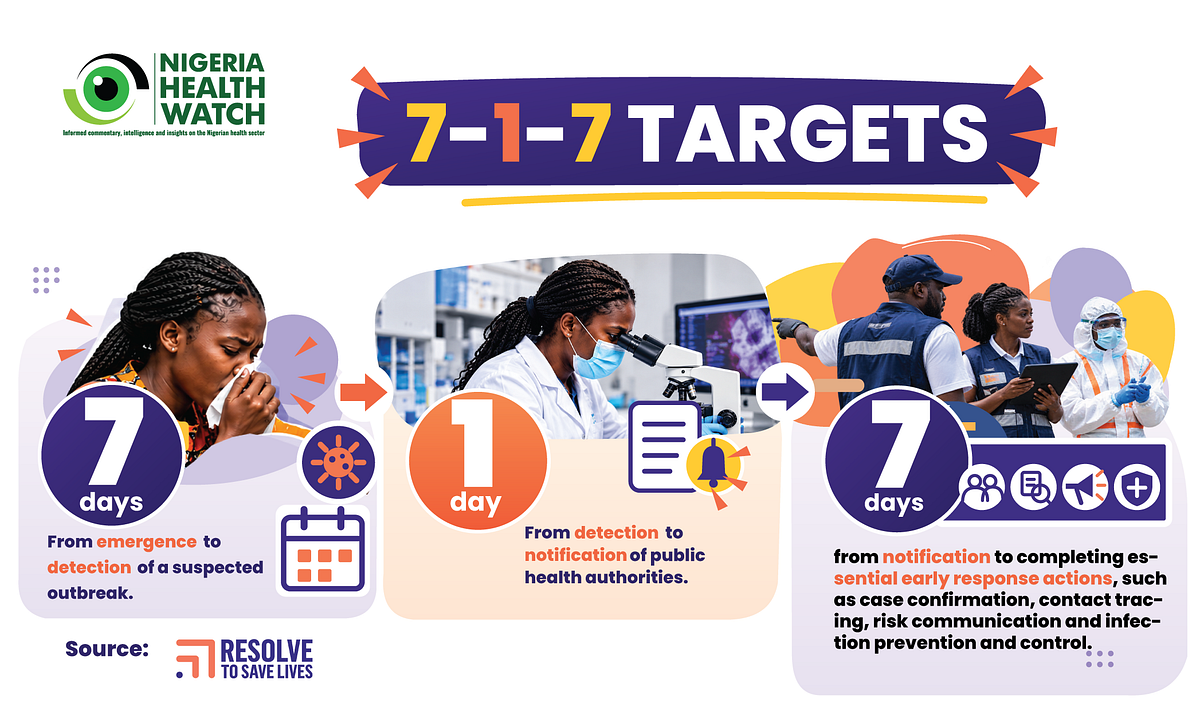
The 7–1–7 framework was designed by Resolve to Save Lives to guide countries in detecting, preparing for, and responding to infectious disease outbreaks. It asks a simple question of every outbreak: how fast did we find it, report it and act on it? More importantly, it asks why: what slowed the response when a target was missed, and what helped it move faster when a target was met, so that what works can be preserved and what does not can be fixed.
Until recently, those answers were used mainly by governments and development partners. Now civil society organisations (CSOs) across Africa are putting 7–1–7 data to work, turning bottlenecks into solutions through targeted training, budget requests and policy asks.
What 7–1–7 actually measures
For years, countries have judged their epidemic readiness through periodic assessments such as the Joint External Evaluation (JEE) and the State Party Self-Assessment Annual Report (SPAR). These list capacities on paper but say little about how they perform together in a real outbreak. 7–1–7, developed by Resolve to Save Lives (RTSL) and partners, fills that gap with three targets for every public health event:
- 7 days from emergence to detection of a suspected outbreak;
- 1 day from detection to notification of public health authorities; and
- 7 days from notification to completing essential early response actions, such as case confirmation, contact tracing, risk communication and infection prevention and control.
The targets are simple, measurable and pathogen-agnostic, which allows them to expose bottlenecks anywhere in the surveillance-response chain. Crucially, 7–1–7 is non-punitive. Missing a target is not a failure to hide; it is information about where to improve. And speed matters: a review of 84 outbreaks in Uganda between 2017 and 2022 linked faster detection to fewer cases, fewer deaths and shorter outbreaks.
The real value for improving performance lies in asking “why?”
Whether a target is missed or met, responders ask what slowed them down and what helped them move faster to chart a path to immediate fixes and longer-term investments, so that the next outbreak is handled better. Using a simple root-cause method known as the “five whys”, teams keep asking why until a series of dates becomes a clear picture of the enablers and bottlenecks behind them.
The7–1–7 Alliance, hosted by Resolve to Save Lives, analysed about 500 bottlenecks across 148 outbreaks in 18 partner countries and identified emerging patterns. Most of the bottlenecks to detection sat at the primary healthcare level. The most common barrier, cited in 28% of outbreaks, was low clinical suspicion.
Nigeria’s data tell a similar story. In the 2025 Lassa fever outbreak in Ondo State, only the one-day notification target was met. Detection took 13 days and early response took 22. The first seven days are critical: without strong surveillance systems, outbreaks grow silently, and bottleneck analysis shows where that silence starts.
Why civil society belongs in the 7–1–7 conversation
Many bottlenecks cannot be fixed by health authorities alone. Unreleased funds, untrained private-sector clinicians and weak community reporting all need pressure and support from outside government. CSOs are using 7–1–7 to make targeted asks, such as a government adopting the 7–1–7 target or a specific budget request or policy change instead of a general call for “more funding for preparedness,” and to urge governments to act on every outbreak review.
- Because 7–1–7 is non-punitive, this advocacy does not need to be adversarial. A CSO can stand beside a ministry of health and say: your own data show this gap, and here is how we can help close it.
Liberia: A CSO tackles a detection bottleneck head-on
Liberia was an early adopter of 7–1–7. It now implements the target nationally and subnationally, uses a dashboard to collect and analyse 7–1–7 data to inform decisions, and has integrated 7–1–7 into national and subnational workflows.
The National Public Health Institute of Liberia (NPHIL) has a dedicated team championing the target, and its experience is documented in a 2025 observational study published in Wellcome Open Research.
When mpox spread, reaching 1,308 laboratory-confirmed cases across all 15 counties by 3 November 2025, 7–1–7 flagged two linked bottlenecks: low clinical suspicion and poor understanding of the mpox case definition. Both were most pronounced in the private sector, the first point of care for many Liberians.
The Healthcare Federation of Liberia (HFL), which represents private health providers, set out to fix this. With the NPHIL, the Montserrado County Health Team, and county partners, it trained health facilities to identify suspected mpox cases using the case definition, report them, and apply infection prevention and control (IPC) measures, and then visited to verify that the training was being used. Follow-up visits found that facilities were better prepared to detect cases and had improved their IPC practices, and monitoring continues.
“HFL’s follow-up after the training found encouraging results across the supported health facilities, with good performance in infection prevention and control, suspected Mpox case identification, and reporting to surveillance teams. These findings suggested that the health workers are applying key competencies reinforced through the training, contributing to improved facility preparedness and stronger disease surveillance.” — Victoria Dweh, Healthcare Federation of Liberia
It was the first time a CSO used 7–1–7 to address a bottleneck directly. Civil society can do more than call for action; it can be part of the fix.
A growing movement across Africa
Building on Liberia’s success, five civil society organisations across four countries are now using 7–1–7 in advocacy. SEND Ghana is pushing for full use of the target in Ghana, while NOPE in Kenya is seeking epidemic preparedness budget lines and consistent use in Narok and Kericho Counties.
People’s Health Movement Kenya is building a CSO coalition and pushing for budgets that address bottlenecks at the national level and in Kisumu, Nairobi, and Migori Counties. In Uganda, Living Goods is helping Wakiso and Mayuge Districts analyse 7–1–7 data to detect outbreaks earlier, and the Healthcare Federation of Liberia is developing budget asks for two priority bottlenecks.
The pathway forward
The 7–1–7 target tells governments how fast they are, and bottleneck analysis tells them why. Civil society can make sure the answers lead to funded, monitored action, but it takes every actor.
Governments should review outbreaks routinely and budget for the fixes. CSOs should build their skills in reading 7–1–7 data, for example through the 7–1–7 Alliance’s 15-minute online course, 7–1–7 Foundations, and track whether commitments are funded. Legislators should ask whether preparedness funds are released on time. Funders should back CSO accountability alongside technical assistance.
The next outbreak is a matter of when, not if. The question is whether it will be found in seven days or seventy. Liberia shows that when civil society works with government on the bottlenecks that matter, the answer can change.
Join the conversation on 29 October 2026 at Strengthening Epidemic Preparedness and Response in Africa: A CSO Working Forum on 7–1–7 and ETDH Advocacy and Accountability, an official side event of the Future of Health Conference 2026.
Register here: https://www.futureofhealthconference.com/register
Leave a Comment
Your email address will not be published. Required fields are marked *