

MCHTrack Is Helping Katsina Reach Women and Children Missing Immunisation and Antenatal Care
Related Stories



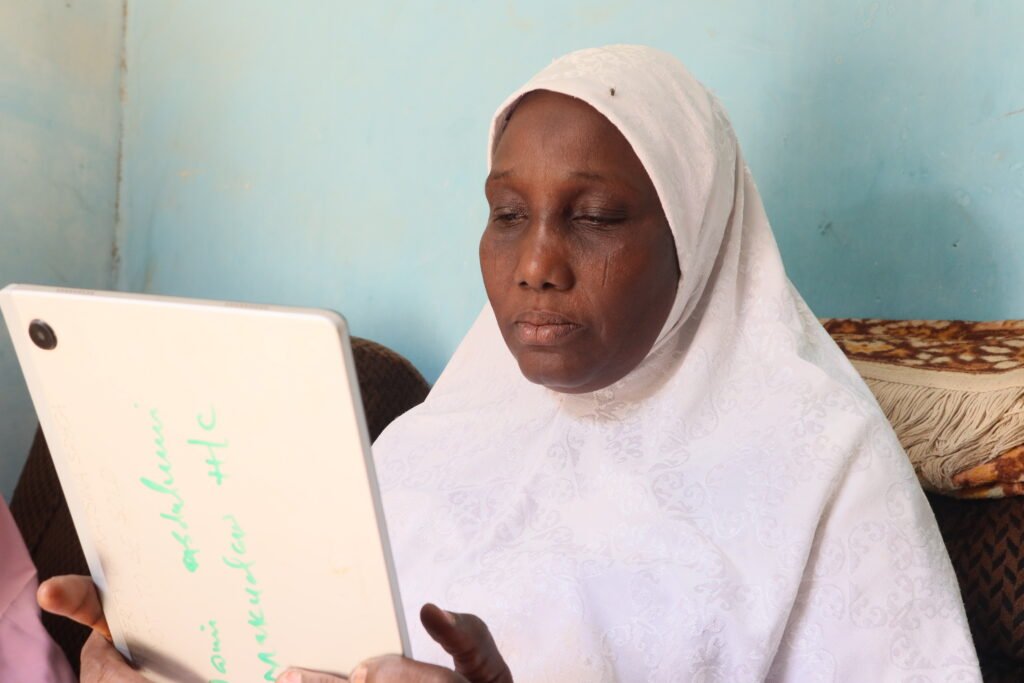
Before 45-year-old Hadiza Umar Danrimi starts her rounds in Katsina, she checks that her tablet is charged connected to the internet. The device, provided by the Katsina State Primary Health Care Development Agency (KSPHCDA), has an application called Maternal and Child Health Track (MCHTrack).
“I move from house to house to ask mothers if their children have been fully vaccinated. Whatever response I get, I record it on the MCHTrack. I refer them to where to get immunised. I also refer pregnant women to a nearby clinic for antenatal care,” Hadiza, a 45-year-old Community Health Influencers, Promoters and Services (CHIPS) programme agent, said.
Hadiza Umar Danrimi and Aisha Ibrahim Yakubu are residents of Katsina, the capital of Katsina State in Northwest Nigeria, and have a deep understanding of the communities there. For the past three years, both have worked as community-based volunteers under the state government’s Community Health Influencers, Promoters and Services (CHIPS) programme.
Katsina’s Zero-Dose Immunisation Gap
Katsina State has more than 171,000 zero-dose children. Zero-dose children are infants who have not received a single dose of a diphtheria, tetanus, and pertussis-containing vaccine (such as DTP1 or Pentavalent 1) by the end of their first year of life. Defaulters are children who started vaccination but did not complete the nationally recommended vaccination schedule for their age.
Eight of 34 local government areas (LGAs) in Katsina State, Batagarawa, Baure, Funtua, Kankara, Katsina, Mani, Rimi and Safana, are among the 100 LGAs nationwide that the United Nations Children’s Fund (UNICEF) reported as zero-dose areas because of their high numbers of children who have not received routine vaccinations.
Data from the Nigeria Demographic and Health Survey (NDHS) shows that vaccination coverage in Katsina has improved in recent years. Penta-3 coverage rose from 33.7% in 2018 to 53.3% in 2024. However, the state is still below the national average of 53.4%, highlighting persistent gaps in reaching children aged 12–23 months with routine immunisation (RI).

Aisha Ibrahim Yakubu, another CHIPS agent who covers six settlements, shared a similar experience. “Each settlement has a population of at least 2,000 people. Every day I go out around 10 a.m. to visit houses, especially those I know are likely to have children who need to be vaccinated. By 2 pm, I return home until the next day. The only day I do not go out is on Sunday,” she said.
How MCHTrack Referrals Reach Health Facilities in Katsina
Murtala Rabe, the Routine Immunisation Officer (RIO) for Katsina LGA, states that the MCHTrack system encompasses all 12 wards within the LGA. He mentioned that the initial criteria established at the launch aimed to identify health facilities with poor routine immunisation (RI) and antenatal care (ANC) performance.

The programme has three to four personnel in every participating facility, including two CHIPS agents, a RI provider, and the facility’s ANC provider. “In terms of the routine immunisation, there are people who have started but later stopped. That is what we call defaulters. They track those defaulters and refer them back to the facilities, so they continue from where they stopped,” he explained.
The local government immunisation officer added that some children never started routine immunisation because insecurity forced their families to leave their communities and relocate to Katsina. Some of the local government areas that contribute the most displaced people in the state are Batsari, Jibia, Danmusa, Kankara, Safana, Sabuwa, Faskari, and Dandume.
“Earlier in their LGAs, they did not patronise those services, but we, the health personnel, know that it is one of our utmost concerns to prioritise RI, ANC services, facility-based delivery and other primary healthcare services,” Rabe said.
He further added that “These CHIPS agents have contributed a lot because displaced persons who now reside in Katsina, before this programme, we only used to go for outreach in order to track them and link them to the PHC services, but when MCHTrack came, it simplified the access to tracking them to the facility. So, we have seen a drastic reduction in the number of zero-dose children and defaulters.”

Scaling MCHTrack’s Reach Across Katsina
Mustapha Lawal, the Katsina State project coordinator for Datharm, the organisation that has provided technical assistance to KSPHCDA on MCHTrack since April 2024, explained that although eight LGAs were outlined, the state could carry out activities in only seven due to heightened insecurity in Kankara LGA. The tool was developed in partnership with UNICEF and the KSPHCDA with funding from Gavi.
Datharm has worked with 76 healthcare facilities across 76 wards in the seven implementing LGAs, “and part of the success, I would say, is that we were able to register more than 420 settlements in these seven LGAs. We were also able to track over 24,350 women and children,” he noted, adding that “up until we handed over the project back to the KSPHCDA, we had identified over 3,500 zero-dose children, and the majority of whom were vaccinated.”
He added that the programme has generated more than 13,700 referrals for antenatal care, routine immunisation and other maternal and child health services through the MCHTrack application. It has also recorded more than 18,200 health facility visits.
According to him, another key achievement is the availability of near-real-time data after synchronisation, which provides up-to-date information on RI performance across the targeted areas. The dashboard that provides this real-time data is reviewed by the KSPHCDA.
What the Tool Has and Has Not Solved in Katsina
Lawal recalled that when implementation began, some community agents struggled to use the Android tablets, but they overcame it with appropriate supervision.
He also cited unreliable connectivity by some network providers as a problem that still affects the work of the community mobilisers. “There is internet in most of the areas, but it is not always effective. Even though it [the application] is designed in a way that can work in low network areas, the app still needs a stronger connection to synchronise the data to the dashboard and the server,” he noted.
The availability of tablets at health facilities also emerged as a challenge. Each facility is assigned one tablet, so when the device is in use by the ANC unit, it cannot be accessed simultaneously by the RI team. As a result, some health workers had to wait for the device before carrying out their activities. However, Lawal mentioned that the issue has now been resolved through the involvement of the LGA Primary Health Care department.
Another challenge is the relocation of mobilisers. According to Mustapha Lawal, when a community mobiliser leaves, it takes a lot of time and effort to train the next mobiliser because the role is unpaid.
Lessons for Scaling MCHTrack in Katsina
Lawal said the main implementation lesson was the importance of coordination. “The state is important. The state stakeholders are important. The local government officials, that is, the local government stakeholders, and the community leaders are also important. The mobilisers are also important.”
He concluded by saying, “At the health facility, the in-charge is important. The RI providers are equally important. So, what I can see is that the collaboration among all of these entities is very, very important and something we had to embrace before we could achieve much of what we have.”
MCHTrack stands as a good example of how innovative solutions can help communities get immunised while improving maternal health outcomes.
Leave a Comment
Your email address will not be published. Required fields are marked *