
Nigeria’s Agricultural Commitments Must Deliver Better Nutrition
Related Stories


Imole Agunbiade and Maureen Moneke (Lead writers)
According to World Bank data, Nigeria had 36.872 million hectares of arable land in 2023. Productive agriculture depends on farmers having security, reliable inputs, water, research, extension services, roads, storage and access to markets. Households, at the same time, need incomes that can keep pace with rising food prices if they are to afford nutritious diets.
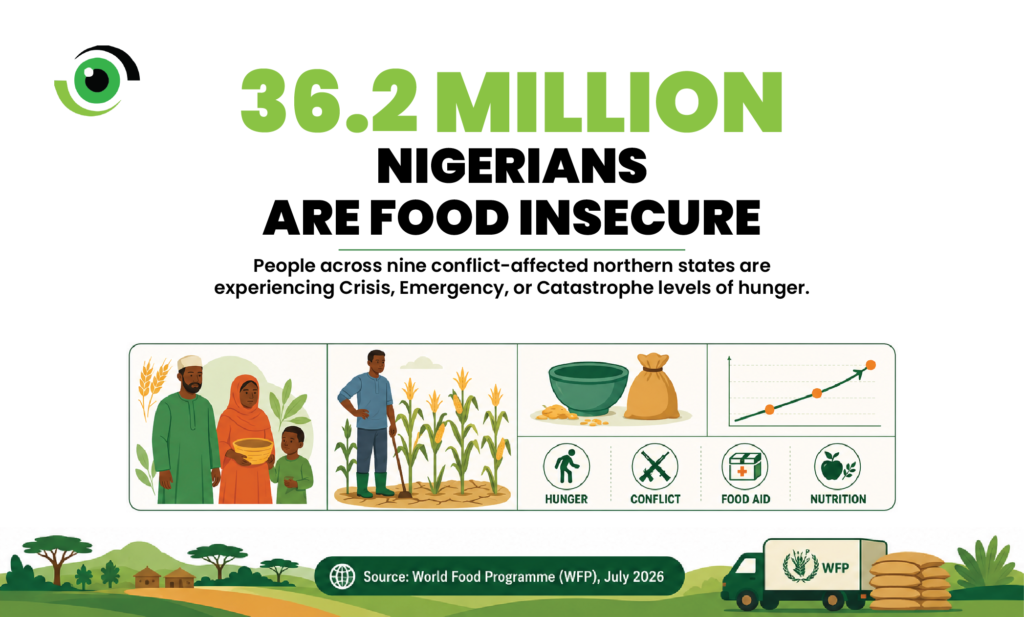
In July 2026, the World Food Programme stated that the number of food-insecure people nationwide had risen to 36.2 million. Within that wider crisis, a recently completed Cadre Harmonisé hotspot analysis found that more than 17 million people across nine conflict-affected northern states were experiencing crisis, emergency or catastrophic levels of hunger. Conflict is forcing people from farmland, increasing displacement and restricting humanitarian access. Severe funding shortages have also reduced the assistance available to affected communities.
Nigeria’s continental commitments
In 2003, African Union member states adopted the Maputo Declaration, committing at least 10 per cent of public expenditure to agriculture and setting a target of at least 6 per cent annual agricultural growth. The Malabo Declaration, adopted in 2014, renewed and expanded those commitments.
At the African Union Summit in Kampala in January 2025, African leaders adopted two new instruments: the Kampala CAADP Declaration and the CAADP Strategy and Action Plan for 2026–2035. The new framework broadens the focus beyond agricultural production to cover food and nutrition security, trade, climate resilience, inclusion and stronger governance of agrifood systems.
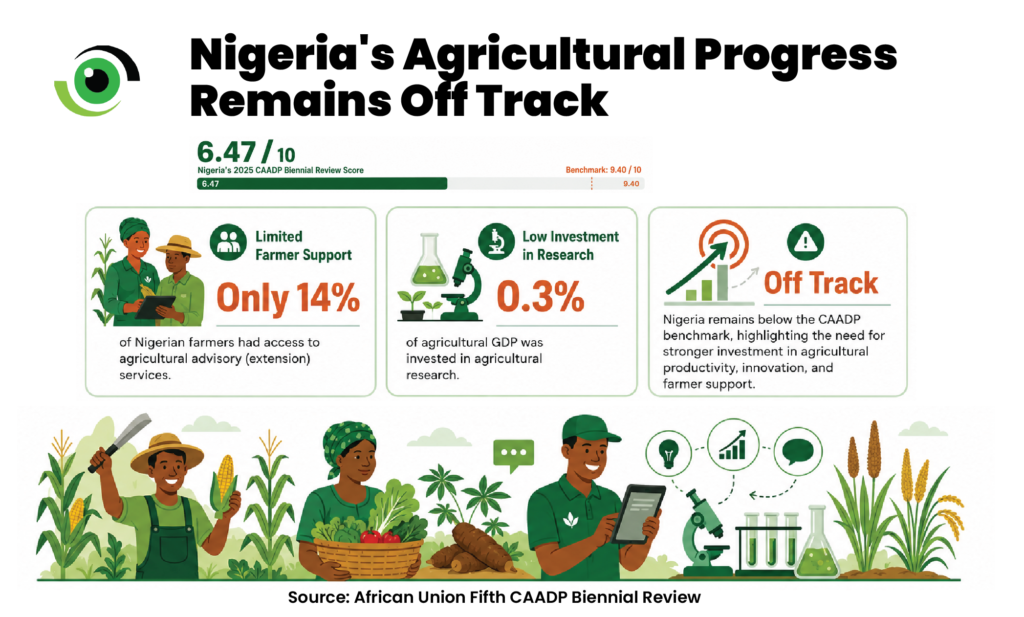
Nigeria will begin implementing this new framework after falling short of several commitments under the Malabo Declaration. In the African Union’s fifth CAADP Biennial Review, published in 2025, Nigeria scored 6.47 out of 10, against the benchmark of 9.40, and was classified as not on track. Nigeria was off track on public expenditure on agriculture, agricultural productivity, post-harvest loss reduction, social protection, and food security and nutrition. The scorecard also found that only 14 per cent of farmers had access to agricultural advisory services, while spending on agricultural research amounted to just 0.3 per cent of agricultural GDP.
Meeting the 10 per cent commitment cannot be determined from the Federal Ministry of Agriculture’s budget. The target applies to qualifying public expenditure on agriculture across all levels of government. To strengthen accountability and transparency, federal, state, and local authorities should publish what they consider agricultural spending, how much was budgeted, released, and ultimately spent, and the outcomes achieved.
How agriculture affects nutrition
In June 2024, UNICEF estimated that approximately 11 million Nigerian children under five, one in three were living in severe child food poverty. This means consuming foods from no more than two of the eight defined food groups. UNICEF reported that these children were up to 50 per cent more likely to experience wasting.
Food availability is only one determinant of child nutrition. Household income, maternal nutrition, feeding practices, health services, safe water and sanitation also matter. The 2024 Nigeria Demographic and Health Survey reported that 29 per cent of infants aged 0–5 months were exclusively breastfed. The Nigeria MICS Plus survey, conducted in three waves between 2023 and early 2025, reported that only 10 per cent of children aged 6–23 months received a minimum acceptable diet.
The burden is particularly severe in the north-east. UNICEF reported in July 2026 that around one million children in Borno, Adamawa and Yobe states were projected to experience life-threatening severe acute malnutrition during the year. Treatment is essential, but prevention also requires families to have reliable access to varied, safe and affordable food.
What must change
1. Publish spending and results. Nigeria needs annual milestones towards the 10 per cent commitment and one reporting framework for qualifying expenditure across all tiers of government. Public reports should distinguish between allocations, releases, and actual spending, and show whether programmes improved production, farmer incomes, food prices, and nutrition.
2. Fund the services farmers need. Agricultural research, extension, irrigation, rural roads, storage, cold chains, veterinary and plant health services, food safety, climate information, and agricultural insurance require sustained public funding. The number of distributed inputs or announced projects is insufficient evidence of impact.
3. Make nutrition a stated result of agricultural investment.Public support should not be assessed only by tonnes of staple crops produced. It should also expand the supply and affordability of legumes, vegetables, fruit, eggs, fish, dairy products and other nutrient-rich foods, while reducing losses between farms and markets.
4. Ensure that support reaches smallholders and women. The government should report who applies for and receives land support, finance, insurance, inputs, training and market assistance. The information should be disaggregated by sex, location, age, and farm scale, so that exclusions can be identified and corrected.
5. Protect the public interest in agricultural partnerships.Agreements on irrigation, processing, storage, logistics and digital services should disclose government commitments, subsidies, guarantees and other fiscal risks. They should also protect community land rights and set measurable requirements for smallholder participation and food affordability.
Agriculture, health, education, water and social-protection institutions must work towards shared nutrition targets. Breastfeeding support, treatment for acute malnutrition, school meals, safe water and well-targeted cash assistance remain necessary even when agricultural production increases.
Nigeria’s National Agri-Food Systems Investment Plan 2026–2027 provides an immediate test. It sets out seven programmes and ₦6.5 trillion in planned investments, including measures on productivity, finance, climate-smart agriculture, gender inclusion and nutrition-sensitive food systems.
Planned investment is not the same as released or spent funding. The government should therefore publish annual work plans, financing sources, releases, procurement information, and progress against measurable outcomes.
By the end of 2027, Nigerians should be able to see what has changed, whether more farmers received useful extension support, food losses fell, farm incomes became more stable, nutritious foods became more affordable, and fewer children required treatment for acute malnutrition. Without this evidence, the commitment remains another promise.
Leave a Comment
Your email address will not be published. Required fields are marked *