
Less Aid. Tougher Choices. What Lies Ahead for the Next Global Fund Executive Director?
Related Stories



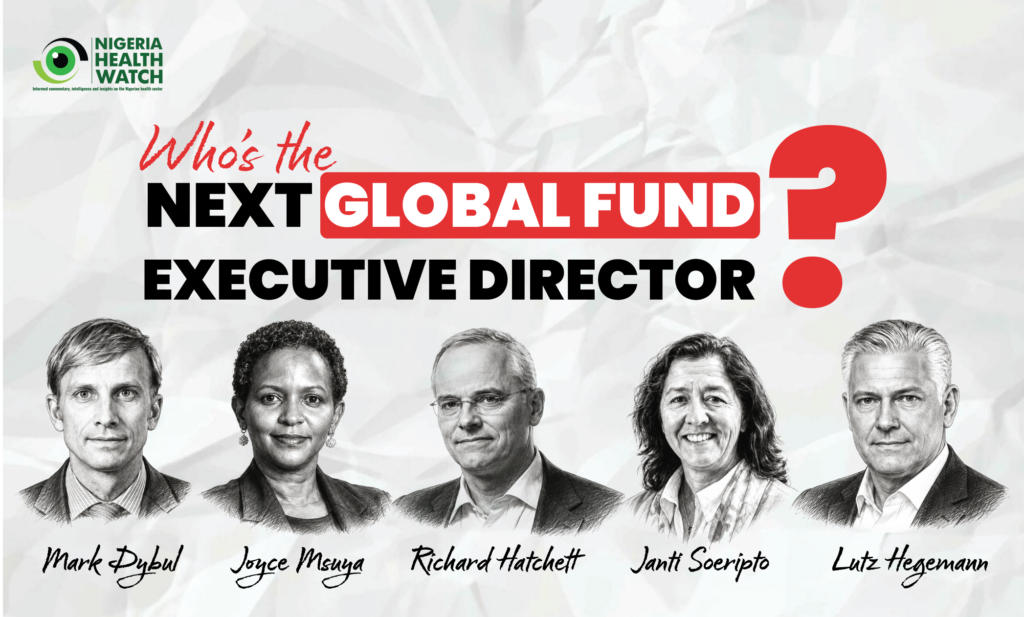
This week, the Board of the Global Fund to Fight AIDS, Tuberculosis and Malaria meets in Geneva to appoint its next Executive Director. Five finalists remain from a global search launched in February 2026.
Whoever is chosen at the 56th Board Meeting, scheduled for 28 to 30 October, will take office in the first quarter of 2027, succeeding Peter Sands, who has led the organisation since 2018.
The new leader inherits a smaller purse. The Global Fund’s Eighth Replenishment closed at US$12.64 billion, short of its US$18 billion target and below the US$15.7 billion pledged at the Seventh Replenishment in 2022.
The Board has approved US$10.78 billion for country allocations for 2026 to 2028. All of this sits within a wider collapse in aid: official development assistance fell by 23.1% in real terms in 2025, the largest annual decline ever recorded, according to preliminary figures from the Organisation for Economic Co-operation and Development (OECD).
For Nigeria, the stakes are especially high. The country remains one of the Global Fund’s priority portfolios, with a Grant Cycle 8 allocation of about US$792 million for HIV, tuberculosis and malaria, though lower than in the previous cycle.
That support now comes with clearer expectations of efficiency and national ownership. The person who leads the Global Fund, and the choices they make in their first year, will shape how Nigeria manages that shift.
To gather a range of perspectives on the qualities and experience the next leader needs, Nigeria Health Watch asked seven senior global health professionals working across international agencies, national disease programmes and academia two questions: what skills the next Executive Director will need to lead through shifting geopolitics and funding cuts, and what they should prioritise in their first 12 months.
Their responses align on what must be protected and point to a harder debate about who should hold power in global health.
Diplomacy alone will not be enough
Political and diplomatic skills emerged as a common theme in the responses, reflecting the relationship the next Global Fund Executive Director must manage simultaneously, with the current United States administration, European donors under severe financial pressure, and low-income countries committed to health financing sovereignty but still developing clear roadmaps to achieve it.
Fundraising emerged as an early priority in the responses: holding donors to their replenishment pledges to prevent new grants from being delayed, and diversifying revenue through innovative finance.
The next Executive Director will also need to look beyond government donors to emerging sources of private philanthropic wealth, engaging funders who place a premium on data and measurable results. This funding must build on the slow but important shift towards countries financing their own health priorities.
Working with governments to direct new resources through national health systems would help strengthen the capacity to deliver care while keeping countries’ priorities at the centre.
Yet expectations extended beyond raising funds. The next Executive Director must “engage ministries of finance as effectively as ministries of health,” and earn the trust of implementing countries and affected communities. Operational and financial stewardship also featured strongly, including a track record in “complex people management and proactive risk management that balance risk taking with compliance, fraud mitigation, and operational accountability.”
Courage stood out as essential to following the evidence, even when funders push in other directions. As one leader put it, “The next leader will need the courage to remain engaged and strengthen national systems rather than create workarounds or fund parallel delivery organisations.”
This also means making transparent choices when resources are constrained and building consensus around difficult trade-offs.
Protect the gains, plan the exits
There was broad agreement on the immediate priorities. The first task is to protect HIV, tuberculosis and malaria services so that two decades of progress are not reversed as funding falls. The second is to make transitions to domestic financing deliberate, with timelines and responsibilities agreed in advance rather than imposed when funds run short.
One leader called for “a credible transition compact” that protects existing gains while accelerating country ownership and domestic investment. Another proposed approach is to agree and monitor transition and co-financing roadmaps with every recipient country, supported by a transparent process for deciding what gets funded first.
There was also a clear warning that a rushed, poorly planned transition could undo gains built over 20 years.
From ownership to authority
Beneath this consensus sits a sharper argument. The model the Global Fund has relied on since 2002 was called into question. The Fund has set a high threshold for funding government public health agencies; however, there are fiduciary weaknesses. It has channelled funds through non-governmental organisations.
“Given the scale of its resources, this approach has distorted national systems and created perverse incentives, often leaving the government agencies picking up the crumbs,” one noted.
Another questioned how authority is distributed across global health. “When authority follows money alone, both sides can become trapped in unhealthy habits,” they said.
Financiers come to expect influence over priorities, while recipients accommodate agendas rather than take full responsibility for difficult reforms. In their view, the next leader must comfortably work with Africa CDC and other regional institutions as legitimate partners in shaping priorities, governance and accountability, rather than merely as implementers.
These concerns were echoed in calls to review non-governmental principal recipients that repeatedly fail to strengthen national capacity, and to invest in government fiduciary systems so that funds can flow through them.
Views differed, however, on how wide the Global Fund’s remit should be. Those questioning its expansion pointed to its origins as an emergency mechanism for HIV, tuberculosis and malaria.
They argued that its subsequent investment in health systems and pandemic preparedness has rarely aligned with countries’ development priorities, and that the impact is less evident than its gains against the three diseases.
Others saw deeper investment in primary healthcare, laboratories and supply chains as essential, alongside closer integration of disease programmes into national health systems.
Governments and communities need each other
Finding the balance is harder than it sounds. The responses also emphasised that community-led organisations and community health workers must remain at the heart of the response. “Commodities are essential, but without the people and systems that deliver them, particularly at community level, their impact will remain limited”
There were also calls for civil society to hold governments to account for how health money is raised and spent. Community-led monitoring, in which affected communities collect data on the services they receive, could be formalised so that their findings shape how grants are designed and improved.
A leaner Global Fund
Calls for internal reform focused on what was described as a “bloated internal bureaucracy” with proposals for a smaller Secretariat and a leaner funding request process built on costed national plans. A review of the operating model was also proposed, backed by an implementation plan with measurable, time-bound outcomes and a marked reduction in operating costs.
These proposals extended to a problem countries know well, competing donor systems. The next leader would need to set out a clear position on aligning Global Fund investments with those of Gavi, the Pandemic Fund, the United States Government, and the Gates Foundation, to support countries in working toward one national strategy, one results framework, and one accountability system.
What should progress look like after 12 months?
Expectations for concrete progress centred largely on documents: a transition framework, a roadmap, a reform plan. Yet the responses also included a more demanding standard: measurable gains against published baselines, including fewer commodity stock-outs and treatment interruptions, faster grant disbursement, and domestic contributions released in line with commitments.
This expectation applies to Nigeria as much as to the Global Fund. Nigeria pledged US$15 million to the Eighth Replenishment, and across all replenishments, Nigeria has pledged US$109.28 million and contributed US$38.79 million.
The gap between allocation and release is familiar. In 2025, the Coordinating Minister of Health and Social Welfare told the House of Representatives that only ₦36 million of the ministry’s ₦218 billion capital allocation had been released
Any transition plan agreed with the Global Fund will only work if Nigeria releases the funds it has committed.
What should happen next?
The responses leave a clear challenge for the next Executive Director: turn promises of reform into changes that countries and communities can see. How soon will funding requests become simpler, disbursements faster, and Secretariat costs lower? Will countries have a public roadmap showing what the Global Fund will finance, what governments must contribute and when each commitment falls due?
The answers will also depend on where authority sits. Working through national institutions and regional bodies such as Africa CDC requires investment in their capacity to manage funds and deliver results. It also requires a willingness to entrust them with decisions. Civil society and affected communities must have the support to scrutinise those decisions, with community-led monitoring shaping grants and exposing failures early enough to correct them.
Nigeria faces questions of its own. Will the Federal Ministry of Health and Social Welfare and the Federal Ministry of Finance release co-financing commitments and the replenishment pledge on schedule? Will health tax revenues go to health in line with the Nigeria Healthcare Financing Policy? Calls for greater ownership carry little weight if the funds promised do not follow.
The Board will name a leader this week. The harder test begins in early 2027, when that leader must show, in measurable terms, that the Global Fund can protect the gains already made while shifting more decision-making power to the countries responsible for sustaining them. As one contributor put it, “the next era of global health and international development must be defined by shared authority, shared accountability and shared agency, rather than by a system in which financing power automatically confers decision-making power”.
For Nigeria, the test runs both ways. As the Global Fund makes room for stronger national ownership, Nigerians should expect their government to match that authority with the funding and accountability it demands.
Leave a Comment
Your email address will not be published. Required fields are marked *