
Nigeria Health Watch to Spotlight Nigeria’s Data-Driven Approach to Malaria Control Ahead of World Mosquito Day
Related Stories

New research highlights how subnational tailoring is helping Nigeria move away from one-size-fits-all malaria interventions and use local evidence to guide planning and resource allocation
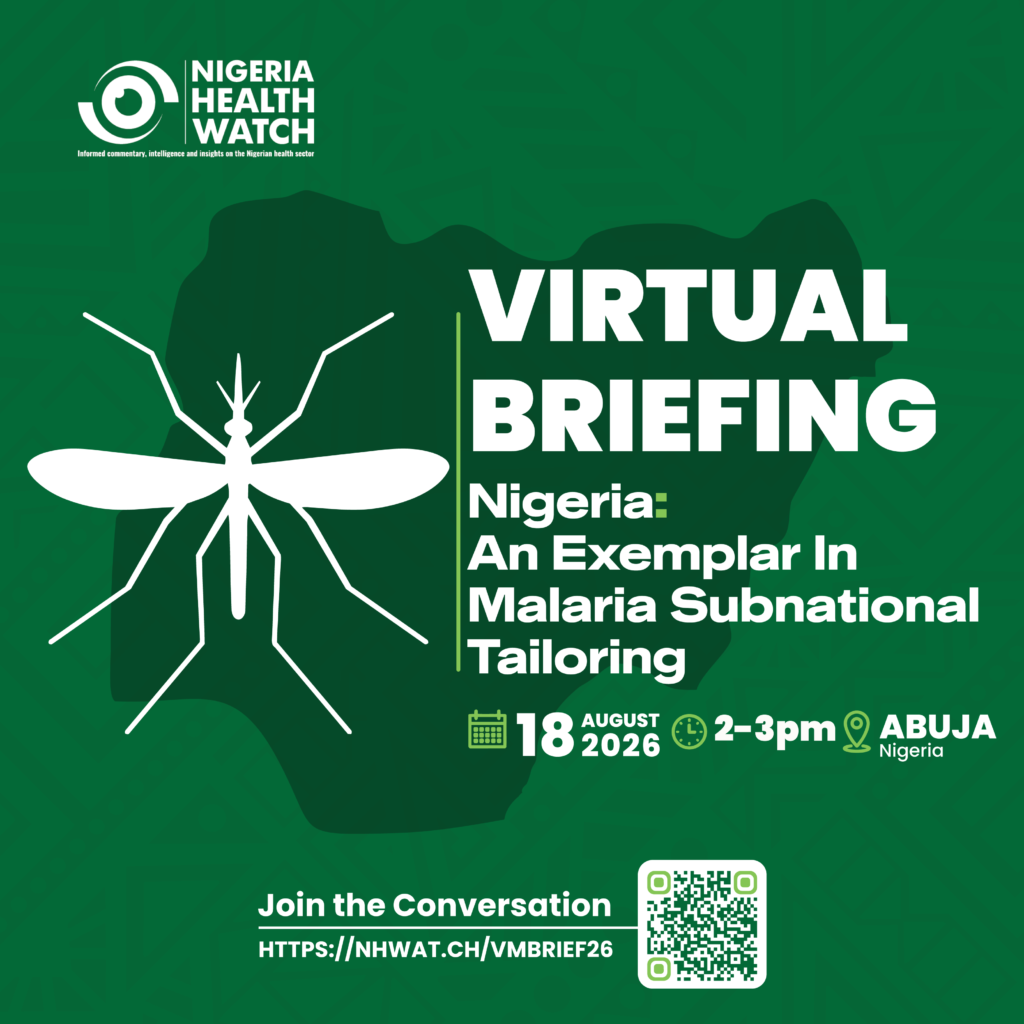
Nigeria Health Watch will host a virtual briefing on Tuesday, 18 August 2026, to discuss new research examining Nigeria’s progress in using subnational tailoring (SNT) to strengthen malaria control.
The briefing comes ahead of World Mosquito Day, observed annually on 20 August, providing an opportunity to examine how Nigeria can sustain and build on progress in tackling one of its most persistent public health challenges.
The research brief, “Learning from Nigeria’s Exemplary Progress in Malaria SNT,” examines Nigeria’s shift towards a more participatory, data-driven approach to malaria programming that recognises significant differences in malaria transmission, health system capacity, poverty, conflict, climate and other contextual factors across states and local government areas.
Malaria remains a significant challenge for Nigeria. In 2018, the country accounted for approximately one-quarter of malaria cases globally and 24% of global malaria deaths. Yet malaria risk within Nigeria is far from uniform: prevalence and transmission vary considerably between states and communities.
Recognising these differences, Nigeria introduced SNT in 2019, building on the World Health Organisation’s High Burden to High Impact initiative. The approach uses granular evidence to help policymakers determine which interventions are most appropriate for particular states and local government areas and make better use of limited resources.
“Malaria does not affect every community in Nigeria in the same way, and our response cannot afford to treat it as though it does,” said Vivianne Ihekweazu, Managing Director, Nigeria Health Watch. “This research demonstrates the importance of generating and using local evidence to understand where needs are greatest, determine which interventions are most appropriate, and make increasingly difficult decisions about how limited resources should be deployed.”
From data to action
Nigeria’s SNT journey has been supported by stronger coordination between national and subnational stakeholders and improvements in how malaria data are collected, integrated and used.
In 2020, Nigeria launched the National Malaria Data Repository, bringing together routine surveillance, household surveys, campaign monitoring and partner datasets. The platform strengthened data accessibility, quality and tracking and created a more comprehensive evidence base for malaria decision-making.
This evidence has informed tangible changes in malaria programming. By 2023, seasonal malaria chemoprevention had expanded to 21 of Nigeria’s 36 states. SNT evidence has also informed routine distribution of insecticide-treated nets in southern Nigeria, targeted indoor residual spraying in malaria hot spots, and rollout of the R21 malaria vaccine in selected states, with plans to scale up.
Nigeria’s national malaria parasite prevalence declined from 27% in 2015 to 15% in 2025.
The research also highlights the role of SNT in financing decisions. Subnational stratification, intervention mixes and costed operational plans have informed Global Fund grant negotiations and the US President’s Malaria Initiative (PMI) investment decisions, while modelling has helped decision-makers compare interventions and prioritise resources based on their projected impact.
Progress must be sustained
Despite this progress, the research identifies significant barriers to sustaining and expanding SNT in Nigeria. These include gaps in routine surveillance and private-sector data, uneven technical and analytical capacity, unreliable financing, fragmented supply chains and logistical bottlenecks that can limit the reach of malaria interventions.
These challenges are particularly important as the malaria response faces an increasingly constrained financing environment.
The research recommends that governments embed SNT within annual health planning and budgeting, invest in domestic analytical capacity, strengthen data quality and use SNT to make evidence-based prioritisation decisions as funding becomes more constrained.
For donors, the brief recommends aligning funding with SNT-informed priorities to reduce duplication and ensure investments reflect state-specific malaria burden, transmission intensity and health system needs. It also calls for sustained investment in surveillance, analysis, monitoring and evaluation, and capacity strengthening.
Virtual briefing ahead of World Mosquito Day
Nigeria Health Watch’s virtual briefing on Tuesday, 18 August 2026, will bring together the media, researchers and key stakeholders to unpack the findings, explore lessons from Nigeria’s experience and discuss what is required to sustain a more targeted, evidence-driven malaria response.
The conversation will also examine the implications of the research for policymakers, funders, implementing partners and other malaria-endemic countries seeking to achieve greater impact with limited resources.
The briefing precedes World Mosquito Day on 20 August, providing a timely opportunity to move the conversation beyond malaria burden alone and towards how evidence can help improve the effectiveness and efficiency of malaria interventions.
Virtual Briefing Details
Date: Tuesday, 18 August 2026
Time: 2:00 PM – 3:00 PM WAT
Registration/Joining Link: https://nhwat.ch/VmBrief26
About the Research
The Exemplars Malaria Subnational Tailoring study examines the facilitators and barriers to planning, implementing, and sustaining tailored malaria interventions, with the aim of identifying opportunities to improve resource allocation and malaria control, and to generate lessons for other countries implementing SNT.
Nigeria Health Watch conducted the Nigerian research between 2025 and 2026 in collaboration with the Harvard T.H. Chan School of Public Health and Applied Health Analytics for Delivery and Innovation (AHADI). Northwestern University also contributed to the research. The Gates Foundation and Gates Ventures funded the study.
About Nigeria Health Watch
Nigeria Health Watch is a health communication and advocacy organisation dedicated to strengthening Nigeria’s health system by using evidence, storytelling, advocacy and strategic communication to hold stakeholders accountable, influence policy and ensure that health remains a national priority.
ENDS
For media enquiries and virtual briefing attendance:
Asari Ndem
Nigeria Health Watch
andem@nigeriahealthwatch.com
+234 8173476154
Leave a Comment
Your email address will not be published. Required fields are marked *