
As Efforts Intensify to Contain Bundibugyo Ebola, Women Remain Most Vulnerable to Its Economic Impact
Related Stories


The escalating Bundibugyo Ebola outbreak has sparked renewed international concern after French health authorities confirmed an imported case in a doctor returning from the Democratic Republic of the Congo (DRC) on June 23. While the case marks the outbreak’s reach beyond endemic countries, the patient was immediately isolated, and contact tracing was initiated. The patient has since recovered and left the hospital. Authorities saythere is no evidence of onward transmission in Europe.
The imported case comes as the outbreak intensifies. As of July 1, 2026, the DRC had recorded1,460 confirmed cases and 452 deaths, while neighbouring Uganda had reported 20 confirmed cases and two deaths. Both countries are endemic for Ebola viruses, with the DRC experiencing recurrent outbreaks and Uganda having a history of outbreaks caused by multiple Ebola virus species.
While containing the outbreak remains an urgent priority, its consequences extend far beyond clinical containment. A recent reporttitled ‘Rapid Socioeconomic Assessment of the Ebola Outbreak in the DRC’,published by the United Nations Development Programme (UNDP), describes Ebola as a “development and economic crisis” with consequences for livelihoods, trade, education, public finances and essential health services.
Under the report’s macroeconomic scenario, if the Ebola outbreak remains contained in the DRC and Uganda, the report estimates that precautionary border restrictions, screening delays, trade disruptions, and reduced investor confidence could still cost the DRC, Uganda, and eleven neighbouring Sub-Saharan African countries an estimated US$2.37 billion in real Gross Domestic Product (GDP) and about 90,000 formal jobs.
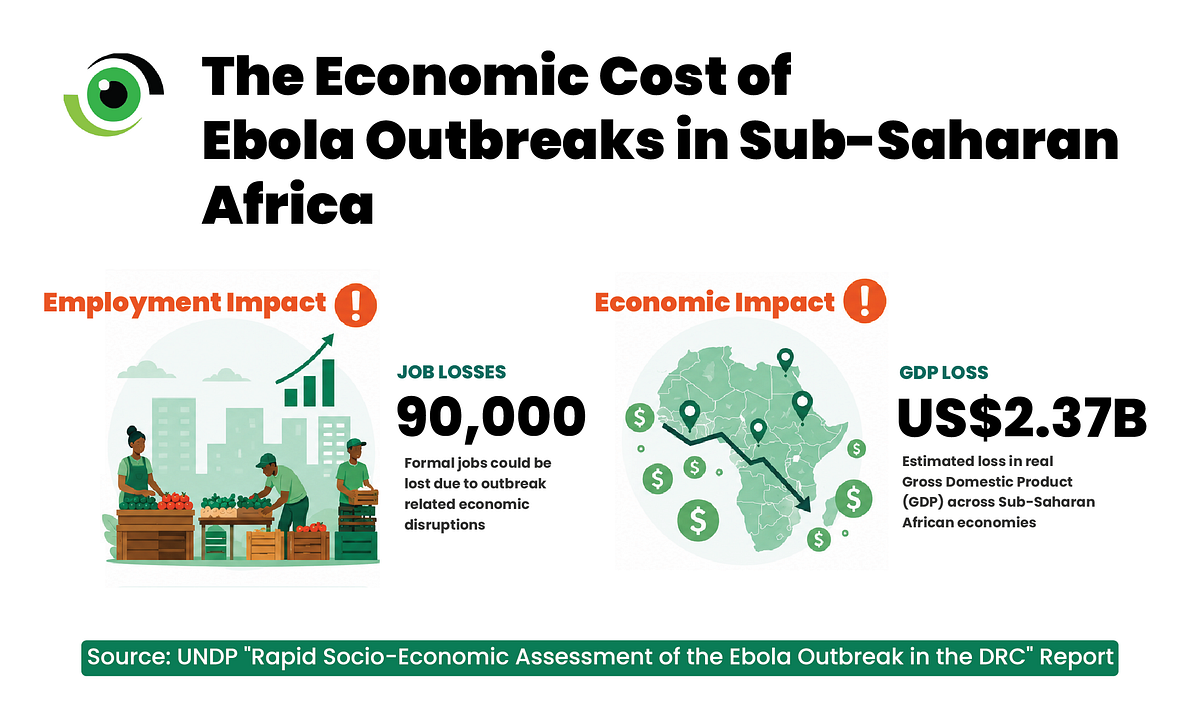
Under this best-case regional scenario, the largest economic losses outside the two affected countries are projected in Angola, Rwanda, South Sudan, and Zambia, while investment is expected to decline most sharply in Rwanda and Kenya due to heightened uncertainty.
Why Ebola’s burden is gendered
The latest WHO situation reports also suggest that the Bundibugyo Ebola outbreak is no longer only a public health emergency but an escalating socioeconomic crisis.
As transmission continues in the DRC, response efforts are being complicated by insecurity, attacks on health facilities, population movement and the absence of a licensed vaccine or specific treatment for the Bundibugyo strain.
These disruptions are likely to disproportionately affect women, who make up much of the informal workforce and the frontline health and caregiving labour force. The UNDP’s socioeconomic assessment identifies four ways through which the outbreak could deepen existing gender inequalities.
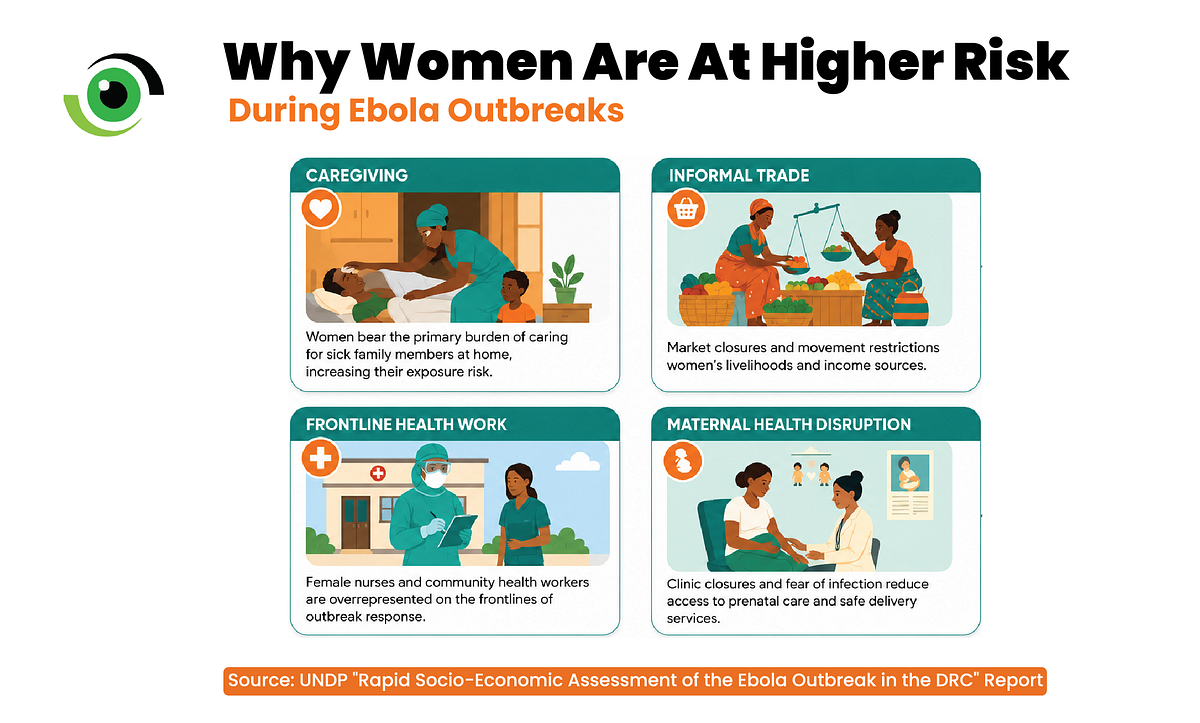
1. Elevated risk to women’s lives: Previous Ebola outbreaks show that women often face disproportionate exposure because they are more likely to care for sick relatives, wash clothes and bedding, prepare food, support childbirth, and participate in care or burial practices that may involve contact with infectious body fluids.
Women are also highly exposed in health facilities where they are often represented among nurses, midwives, community health workers, cleaners and laundry staff, roles that bring them into close contact with patients, waste, linen and contaminated materials.
2. Livelihood disruptions and informal sector shocks: Beyond direct exposure, outbreaks also intensify women’s unpaid care responsibilities, reducing the time available for paid work, education, and participation in community life.
Women are heavily represented in small-scale retail, agricultural processing, and informal cross-border trade; therefore, movement restrictions and market closures can disrupt daily cash flow.
Additionally, when formal entry points implement rigid clearances, the UNDP noted that female traders are often displaced into unofficial, more dangerous pathways, exposing them to heightened security risks and financial extortion.
3. Maternal healthcare disruption: As public health emergencies strain already fragile health systems and redirect resources toward outbreak response, essential maternal and reproductive health services are often disrupted. This diversion undermines access to safe obstetric care, antenatal services, skilled birth attendance, and routine immunisation.
Evidence from previous Ebola outbreaks in West Africa shows that these interruptions contributed to significant increases in maternal and neonatal deaths, with many preventable fatalities resulting from reduced access to timely, quality healthcare rather than the disease itself.
4. Security risks: In conflict-affected and displaced communities, containment measures can weaken safety networks. Internally displaced women, widows, women with disabilities and female-headed households may face higher risks of gender-based violence (GBV), exploitation, and abuse when they leave safer areas to seek food, water, income or healthcare.
At the same time, access to essential services, including GBV response mechanisms, psychosocial support, and sexual and reproductive healthcare, is often disrupted.
Mitigating the impact
To mitigate disruptions to maternal and reproductive healthcare services, governments and health partners must ensure that reproductive health clinics, maternity wards, and antenatal care services remain fully operational, adequately resourced, and functionally separated from Ebola treatment facilities to guarantee the continuity of essential care.
Because women are heavily represented among low-income informal workers and female-headed households, social protection should prioritise direct cash transfers, food support and livelihood protection for these groups.
Women-led organisations, nurses’ networks, market associations, community leaders and women peacebuilders should be embedded in response governance, not invited only for mobilisation. Their networks can strengthen risk communication, counter misinformation, identify households excluded from services, and build trust between communities and public health authorities.
Leave a Comment
Your email address will not be published. Required fields are marked *